Thoreau’s Journal December 19th, 1854

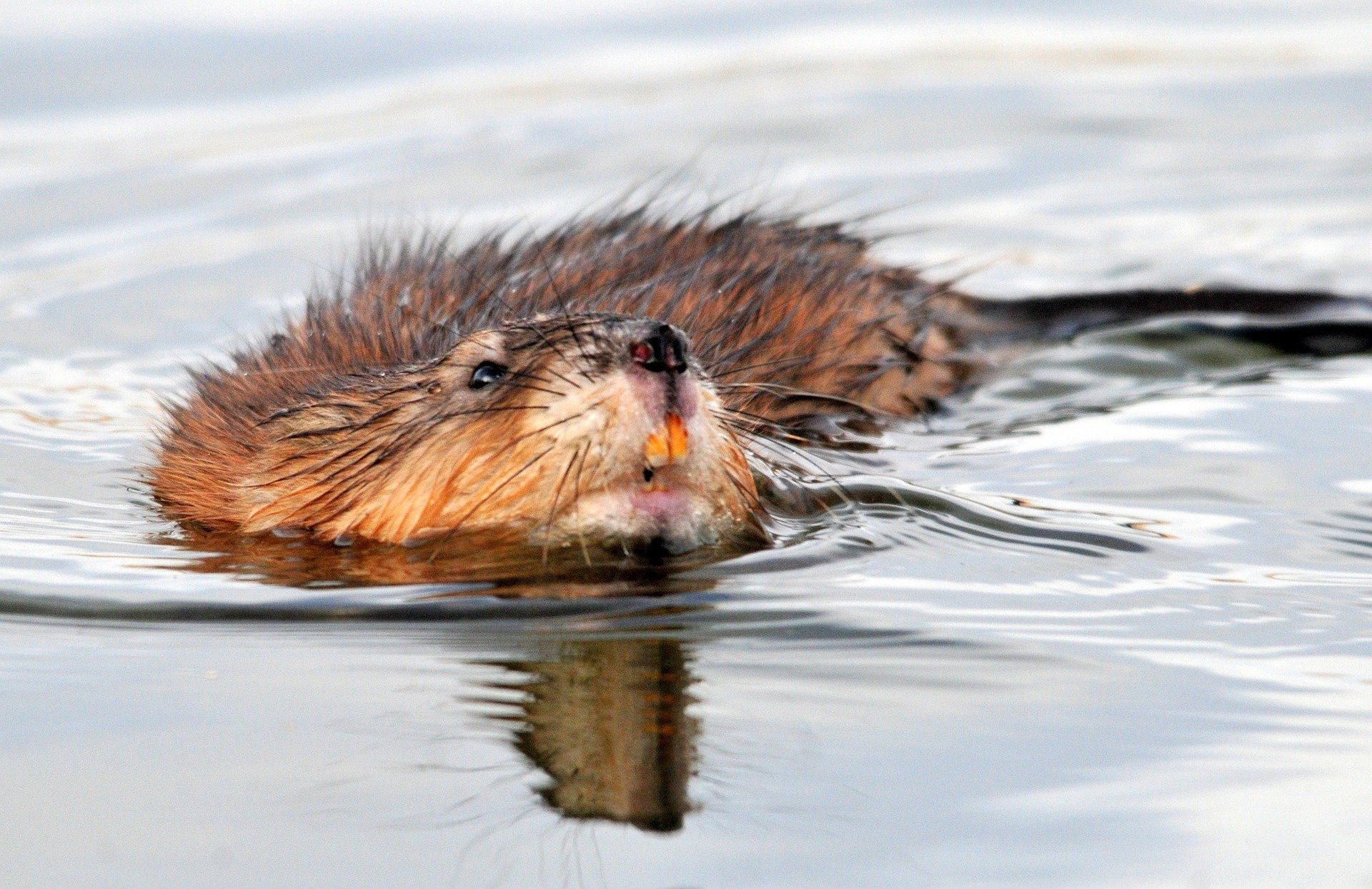
Near the island I saw a muskrat close by swimming in an open reach. He was always headed up-stream, a great proportion of the head out of water, and his whole length visible, though the root of the tail is about level with the water. Now and then he [stopped] swimming and floated down-stream, still keeping his head pointed up with his tail. It is surprising how dry he looks, as if that back was never immersed in the water.

Thoreau’s Journal –December 13, 1859

P. M. – On river to Fair Haven Pond.

My first true winter walk is perhaps that which I take on the river, or where I cannot go in the summer. It is the walk peculiar to winter, and now first I take it. I see that the fox too has already taken the same walk before me, just along the edge of the button-bushes, where not even he can go in the summer. We both turn our steps hither at the same time.

There is now, at 2:30 P. M., the melon-rind arrangement of the clouds. Really parallel columns of fine mackerel sky, reaching quite across the heavens from west to east, with clear intervals of blue sky, and a fine-grained vapor like spun glass extending in the same direction beneath the former. In half an hour all this mackerel sky is gone.

What an ever-changing scene is the sky with its drifting cirrhus and stratus! The spectators are not requested to take a recess of fifteen minutes while the scene changes, but, walking commonly with our faces to the earth, our thoughts revert to other objects, and as often as we look up the scene has changed. Now, I see, it is a column of white vapor reaching quite across the sky, from west to east, with locks of fine hair, or tow that is carded, combed out on each side, – surprising touches here and there, which show a peculiar state of the atmosphere. No doubt the best weather-signs are in these forms which the vapor takes. When I next look up, the locks of hair are perfect fir trees with their recurved branches. (These trees extend at right angles from the side of the main column.) This appearance is changed all over the sky in one minute. Again it is pieces of asbestos, or the vapor takes the curved form of the surf or breakers, and again of flames.

But how long can a man be in a mood to watch the heavens? That melon-rind arrangement, so very common, is perhaps a confirmation of Wise the balloonist’s statement that at a certain height there is a current of air moving from west to east. Hence we so commonly see the clouds arranged in parallel columns in that direction.

A Winter Walk

Though winter is represented in the almanac as an old man, facing the wind and sleet, and drawing his cloak about him, we rather think of him as a merry woodchopper, and warm-blooded youth, as blithe as summer. The unexplored grandeur of the storm keeps up the spirits of the traveler. It does not trifle with us, but has a sweet earnestness. In winter we lead a more inward life. Our hearts are warm and cheery, like cottages under drifts, whose windows and doors are half concealed, but from whose chimneys the smoke cheerfully ascends. The imprisoning drifts increase the sense of comfort which the house affords, and in the coldest days we are content to sit over the hearth and see the sky through the chimney-top, enjoying the quiet and serene life that may be had in a warm corner by the chimney-side, or feeling our pulse by listening to the low of cattle in the street, or the sound of the flail in distant barns all the long afternoon. No doubt a skillful physician could determine our health by observing how these simple and natural sounds affected us. We enjoy now, not an Oriental, but a Boreal leisure, around warm stoves and fireplaces, and watch the shadow of motes in the sunbeams.  — Thoreau

Thanksgiving

“I am grateful for what I am and have. My thanksgiving is perpetual. It is surprising how contented one can be with nothing definite – only a sense of existence. Well, anything for variety. I am ready to try this for the next ten thousand years, and exhaust it. How sweet to think of! my extremities well charred, and my intellectual part too, so that there is no danger of worm or rot for a long while. My breath is sweet to me. O how I laugh when I think of my vague indefinite riches. No run on my bank can drain it, for my wealth is not possession but enjoyment.” 
–Henry David Thoreau in a letter to Harrison Blake (December 6, 1853)

From Muir’s Letter to Emerson 03.26.1872

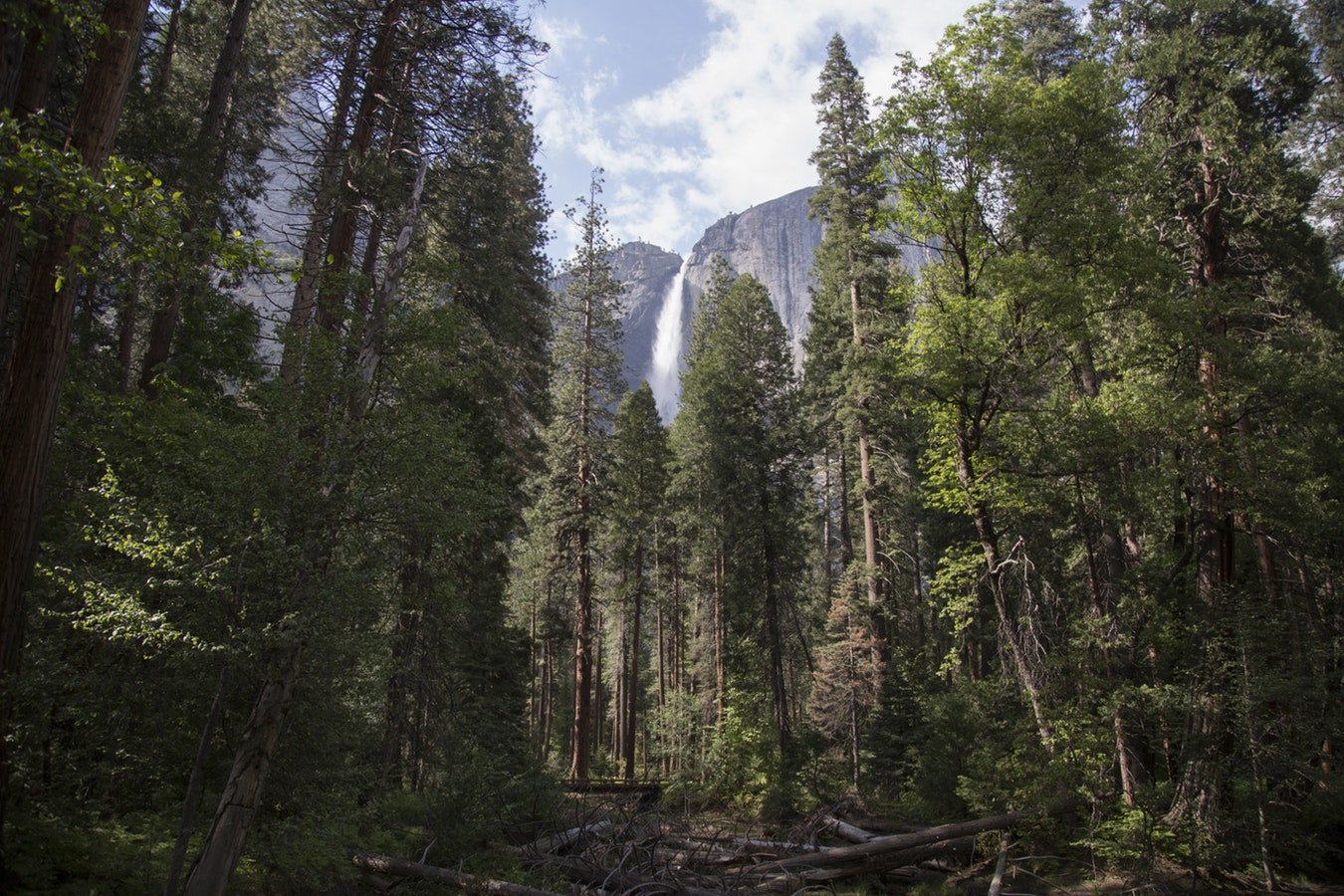
photo-1527822230244-5f2b9919320f.jpeg

I have been going about the valley all morning day, anxious to learn what I could of this magnificent power. The ground is still in motion. It has never fairy settled since the first shock. Between each of the greater shocks a heavy rumbling is heard, not always dis- tinguishable from the explosive notes of the Upper Fall. These are the first spoken words that I have heard direct from the tender bosom of Mother Earth. Frogs cease their songs when a severe shock occurs. I noticed a pair of robins flying with a frightened cheep cheep from a shaken oak. Butterflies seem to know nothing about it. Vertical animals are mostly in sore consternation. Two or three have fled. A little girl of Hutchings cried terror stricken in the night, Grandma Grandma Pray to God to stop it. I met? two violets up by Indian Canon I asked them while I looked in their eyes, what they thought of the great quake storm. They replied It’s all Love . We have lost Eagle Rock but have gained another that is more beautiful, Distruction is always creation; storms of water cloud, Storms of azure wind, purple granite, are things of Beauty Love, working Beauty Love constantly higher yet higher – I did not purpose sending so much storm. I write mostly to repeat my invitation to Yosemite next summer. for this year Pacific letters fly Atlanticward like wounded birds, All are unsteady many fall dead in drifts.

Our thoughts and love are with our friends​, family and all the people of California.

Margaret Fuller On Falsehoods​

Election-2018-Navajo-Presid.jpg

It is astonishing what force, purity, and wisdom it requires for a human being to keep clear of falsehoods.
                                                                                                                    — Margaret Fuller

Ralph Waldo Emerson, Nature

 
b1b8e6547427a7a5c7ae2c0cd9112787_fe4f6758-3534-4a7c-b081-c495f03f2331

Every spirit builds itself a house; and beyond its house a world; and beyond its world, a heaven. Know then, that the world exists for you. For you is the phenomenon perfect. What we are, that only can we see. All that Adam had, all that Caesar could, you have and can do. Adam called his house, heaven and earth; Caesar called his house, Rome; you perhaps call yours, a cobler’s trade; a hundred acres of ploughed land; or a scholar’s garret. Yet line for line and point for point, your dominion is as great as theirs, though without fine names. Build, therefore, your own world.
Ralph Waldo Emerson, Nature

Walking (Final Part)

IMG_7845.jpg

We hug the earth—how rarely we mount! Methinks we might elevate ourselves a little more. We might climb a tree, at least. I found my account in climbing a tree once. It was a tall white pine, on the top of a hill; and though I got well pitched, I was well paid for it, for I discovered new mountains in the horizon which I had never seen before—so much more of the earth and the heavens. I might have walked about the foot of the tree for threescore years and ten, and yet I certainly should never have seen them. But, above all, I discovered around me—it was near the end of June—on the ends of the topmost branches only, a few minute and delicate red conelike blossoms, the fertile flower of the white pine looking heavenward. I carried straightway to the village the topmost spire, and showed it to stranger jury- men who walked the streets—for it was court week—and to farmers and lumber-dealers and woodchoppers and hunters, and not one had ever seen the like before, but they wondered as at a star dropped down. Tell of ancient architects finishing their works on the tops of columns as perfectly as on the lower and more visible parts! Nature has from the first expanded the minute blossoms of the forest only toward the heavens, above men’s heads and unobserved by them. We see only the flowers that are under our feet in the meadows. The pines have developed their delicate blossoms on the highest twigs of the wood every summer for ages, as well over the heads of Nature’s red children as of her white ones; yet scarcely a farmer or hunter in the land has ever seen them.

Above all, we cannot afford not to live in the present. He is blessed over all mortals who loses no moment of the passing life in remembering the past. Unless our philosophy hears the cock crow in every barnyard within our horizon, it is belated. That sound commonly reminds us that we are growing rusty and antique in our employments and habits of thoughts. His philosophy comes down to a more recent time than ours. There is something suggested by it that is a newer testament—the gospel according to this moment. He has not fallen astern; he has got up early and kept up early, and to be where he is is to be in season, in the foremost rank of time. It is an expression of the health and soundness of Nature, a brag for all the world—healthiness as of a spring burst forth, a new fountain of the Muses, to celebrate this last instant of time. Where he lives no fugitive slave laws are passed. Who has not betrayed his master many times since last he heard that note?

The merit of this bird’s strain is in its freedom from all plaintiveness. The singer can easily move us to tears or to laughter, but where is he who can excite in us a pure morning joy? When, in doleful dumps, breaking the awful stillness of our wooden sidewalk on a Sunday, or, perchance, a watcher in the house of mourning, I hear a cockerel crow far or near, I think to myself, “There is one of us well, at any rate,” and with a sudden gush return to my senses.

We had a remarkable sunset one day last November. I was walking in a meadow, the source of a small brook, when the sun at last, just before setting, after a cold, gray day, reached a clear stratum in the horizon, and the softest, brightest morning sunlight fell on the dry grass and on the stems of the trees in the opposite horizon and on the leaves of the shrub oaks on the hillside, while our shadows stretched long over the meadow east- ward, as if we were the only motes in its beams. It was such a light as we could not have imagined a moment before, and the air also was so warm and serene that nothing was wanting to make a paradise of that meadow. When we reflected that this was not a solitary phenomenon, never to happen again, but that it would happen forever and ever, an infinite number of evenings, and cheer and reassure the latest child that walked there, it was more glorious still.

The sun sets on some retired meadow, where no house is visible, with all the glory and splendor that it lavishes on cities, and perchance as it has never set before—where there is but a solitary marsh hawk to have his wings gilded by it, or only a musquash looks out from his cabin, and there is some little black-veined brook in the midst of the marsh, just beginning to meander, winding slowly round a decaying stump. We walked in so pure and bright a light, gilding the withered grass and leaves, so softly and serenely bright, I thought I had never bathed in such a golden flood, without a ripple or a murmur to it. The west side of every wood and rising ground gleamed like the boundary of Elysium, and the sun on our backs seemed like a gentle herdsman driving us home at evening.

So we saunter toward the Holy Land, till one day the sun shall shine more brightly than ever he has done, shall perchance shine into our minds and hearts, and light up our whole lives with a great awakening light, as warm and serene and golden as on a bankside in autumn.

Walking (Part VI)

IMG_7817.jpg

I will not allow mere names to make distinctions for me, but still see men in herds for all them. A familiar name cannot make a man less strange to me. It may be given to a savage who retains in secret his own wild title earned in the woods. We have a wild savage in us, and a savage name is perchance somewhere recorded as ours. I see that my neighbor, who bears the familiar epithet William or Edwin, takes it off with his jacket. It does not adhere to him when asleep or in anger, or aroused by any passion or inspiration. I seem to hear pronounced by some of his kin at such a time his original wild name in some jaw-breaking or else melodious tongue.

Here is this vast, savage, hovering mother of ours, Nature, lying all around, with such beauty, and such affection for her children, as the leopard; and yet we are so early weaned from her breast to society, to that culture which is exclusively an interaction of man on man—a sort of breeding in and in, which produces at most a merely English nobility, a civilization destined to have a speedy limit.

In society, in the best institutions of men, it is easy to detect a certain precocity. When we should still be growing children, we are already little men. Give me a culture which imports much muck from the meadows, and deepens the soil—not that which trusts to heating manures, and improved implements and modes of culture only!

Many a poor sore-eyed student that I have heard of would grow faster, both intellectually and physically, if, instead of sitting up so very late, he honestly slumbered a fool’s allowance.

There may be an excess even of informing light. Niepce, a Frenchman, discovered “actinism,” that power in the sun’s rays which produces a chemical effect; that granite rocks, and stone structures, and statues of metal “are all alike destructively acted upon during the hours of sunshine, and, but for provisions of Nature no less wonderful, would soon perish under the delicate touch of the most subtle of the agencies of the universe.” But he observed that “those bodies which underwent this change during the daylight possessed the power of restoring themselves to their original conditions during the hours of night, when this excitement was no longer influencing them.” Hence it has been inferred that “the hours of darkness are as necessary to the inorganic creation as we know night and sleep are to the organic kingdom.” Not even does the moon shine every night, but gives place to darkness.

I would not have every man nor every part of a man cultivated, any more than I would have every acre of earth cultivated: part will be tillage, but the greater part will be meadow and forest, not only serving an immediate use, but preparing a mould against a distant future, by the annual decay of the vegetation which it supports.

There are other letters for the child to learn than those which Cadmus invented. The Spaniards have a good term to express this wild and dusky knowledge, Gramatica parda, tawny grammar, a kind of mother-wit derived from that same leopard to which I have referred.

We have heard of a Society for the Diffusion of Useful Knowledge. It is said that knowledge is power, and the like. Methinks there is equal need of a Society for the Diffusion of Useful Ignorance, what we will call Beautiful Knowledge, a knowledge useful in a higher sense: for what is most of our boasted so-called knowledge but a conceit that we know something, which robs us of the advantage of our actual ignorance? What we call knowledge is often our positive ignorance; ignorance our negative knowledge. By long years of patient industry and reading of the newspapers—for what are the libraries of science but files of newspapers—a man accumulates a myriad facts, lays them up in his memory, and then when in some spring of his life he saunters abroad into the Great Fields of thought, he, as it were, goes to grass like a horse and leaves all his harness behind in the stable. I would say to the Society for the Diffusion of Useful Knowledge, sometimes, Go to grass. You have eaten hay long enough. The spring has come with its green crop. The very cows are driven to their country pastures before the end of May; though I have heard of one unnatural farmer who kept his cow in the barn and fed her on hay all the year round. So, frequently, the Society for the Diffusion of Useful Knowledge treats its cattle.

A man’s ignorance sometimes is not only useful, but beautiful—while his knowledge, so called, is oftentimes worse than useless, besides being ugly. Which is the best man to deal with—he who knows nothing about a subject, and, what is extremely rare, knows that he knows nothing, or he who really knows something about it, but thinks that he knows all?

My desire for knowledge is intermittent, but my desire to bathe my head in atmospheres unknown to my feet is perennial and constant. The highest that we can attain to is not Knowledge, but Sympathy with Intelligence. I do not know that this higher knowledge amounts to anything more definite than a novel and grand surprise on a sudden revelation of the insufficiency of all that we called Knowledge before—a discovery that there are more things in heaven and earth than are dreamed of in our philosophy. It is the lighting up of the mist by the sun. Man cannot know in any higher sense than this, any more than he can look serenely and with impunity in the face of the sun: “You will not perceive that, as perceiving a particular thing,” say the Chaldean Oracles.

There is something servile in the habit of seeking after a law which we may obey. We may study the laws of matter at and for our convenience, but a successful life knows no law. It is an unfortunate discovery certainly, that of a law which binds us where we did not know before that we were bound. Live free, child of the mist—and with respect to knowledge we are all children of the mist. The man who takes the liberty to live is superior to all the laws, by virtue of his relation to the lawmaker. “That is active duty,” says the Vishnu Purana, “which is not for our bondage; that is knowledge which is for our liberation: all other duty is good only unto weariness; all other knowledge is only the Cleverness of an artist.”

It is remarkable how few events or crises there are in our histories, how little exercised we have been in our minds, how few experiences we have had. I would fain be assured that I am growing apace and rankly, though my very growth disturb this dull equanimity—though it be with struggle through long, dark, muggy nights or seasons of gloom. It would be well if all our lives were a divine tragedy even, instead of this trivial comedy or farce. Dante, Bunyan, and others appear to have been exercised in their minds more than we: they were subjected to a kind of culture such as our district schools and colleges do not contemplate. Even Mahomet, though many may scream at his name, had a good deal more to to live for, aye, and to die for, than they have commonly.

When, at rare intervals, some thought visits one, as perchance he is walking on a railroad, then, indeed, the cars go by without his hearing them. But soon, by some inexorable law, our life goes by and the cars return.

“Gentle breeze, that wanderestunseen,

And bendest the thistlesround Loira of storms,

Traveler of the windyglens,

Why hast thou leftmy ear so soon?”

While almost all men feel an attraction drawing them to society, few are attracted strongly to Nature. In their reaction to Nature men appear to me for the most part, notwithstanding their arts, lower than the animals. It is not often a beautiful relation, as in the case of the animals. How little appreciation of the beauty of the land- scape there is among us! We have to be told that the Greeks called the world Kόσμος, Beauty, or Order, but we do not see clearly why they did so, and we esteem it at best only a curious philological fact.

For my part, I feel that with regard to Nature I live a sort of border life, on the confines of a world into which I make occasional and transient forays only, and my patriotism and allegiance to the state into whose territories I seem to retreat are those of a moss-trooper. Unto a life which I call natural I would gladly follow even a will-o’-the-wisp through bogs and sloughs unimaginable, but no moon nor firefly has shown me the causeway to it. Nature is a personality so vast and universal that we have never seen one of her features. The walker in the familiar fields which stretch around my native town sometimes finds himself in another land than is described in their owners’ deeds, as it were in some faraway field on the confines of the actual Concord, where her jurisdiction ceases, and the idea which the word Concord suggests ceases to be suggested. These farms which I have myself surveyed, these bounds which I have set up, appear dimly still as through a mist; but they have no chemistry to fix them; they fade from the surface of the glass, and the picture which the painter painted stands out dimly from beneath. The world with which we are commonly acquainted leaves no trace, and it will have no anniversary.

I took a walk on Spaulding’s Farm the other afternoon. I saw the setting sun lighting up the opposite side of a stately pine wood. Its golden rays straggled into the aisles of the wood as into some noble hall. I was impressed as if some ancient and altogether admirable and shining family had settled there in that part of the land called Concord, unknown to me—to whom the sun was servant—who had not gone into society in the village—who had not been called on. I saw their park, their pleasure-ground, beyond through the wood, in Spaulding’s cranberry-meadow. The pines furnished them with gables as they grew. Their house was not obvious to vision; the trees grew through it. I do not know whether I heard the sounds of a suppressed hilarity or not. They seemed to recline on the sunbeams. They have sons and daughters. They are quite well. The farmer’s cart-path, which leads directly through their hall, does not in the least put them out, as the muddy bottom of a pool is sometimes seen through the reflected skies. They never heard of Spaulding, and do not know that he is their neighbor—notwithstanding I heard him whistle as he drove his team through the house. Nothing can equal the serenity of their lives. Their coat-of-arms is simply a lichen. I saw it painted on the pines and oaks. Their attics were in the tops of the trees. They are of no politics. There was no noise of labor. I did not perceive that they were weaving or spinning. Yet I did detect, when the wind lulled and hearing was done away, the finest imaginable sweet musical hum—as of a distant hive in May—which perchance was the sound of their thinking. They had no idle thoughts, and no one without could see their work, for their industry was not as in knots and excrescences embayed.

But I find it difficult to remember them. They fade irrevocably out of my mind even now while I speak, and endeavor to recall them and recollect myself. It is only after a long and serious effort to recollect my best thoughts that I become again aware of their cohabitancy. If it were not for such families as this, I think I should move out of Concord.

We are accustomed to say in New England that few and fewer pigeons visit us every year. Our forests furnish no mast for them. So, it would seem, few and fewer thoughts visit each growing man from year to year, for the grove in our minds is laid waste—sold to feed unnecessary fires of ambition, or sent to mill—and there is scarcely a twig left for them to perch on. They no longer build nor breed with us. In some more genial season, perchance, a faint shadow flits across the landscape of the mind, cast by the wings of some thought in its vernal or autumnal migration, but, looking up, we are unable to detect the substance of the thought itself. Our winged thoughts are turned to poultry. They no longer soar, and they attain only to a Shanghai and Cochin- China grandeur. Those gra-a-ate thoughts, those gra-a-ate men you hear of!
Walking (Part V)

IMG_7814.jpg

Linnaeus said long ago, “Nescio quae facies laeta, glabra plantis Americanis” (I know not what there is of joyous and smooth in the aspect of American plants); and I think that in this country there are no, or at most very few, Africanae bestiae, African beasts, as the Romans called them, and that in this respect also it is peculiarly fitted for the habitation of man. We are told that within three miles of the center of the East-Indian city of Singapore, some of the inhabitants are annually carried off by tigers; but the traveler can lie down in the woods at night almost anywhere in North America without fear of wild beasts.

These are encouraging testimonies. If the moon looks larger here than in Europe, probably the sun looks larger also. If the heavens of America appear infinitely higher, and the stars brighter, I trust that these facts are symbolical of the height to which the philosophy and poetry and religion of her inhabitants may one day soar. At length, perchance, the immaterial heaven will appear as much higher to the American mind, and the intimations that star it as much brighter. For I believe that climate does thus react on man—as there is something in the mountain air that feeds the spirit and inspires. Will not man grow to greater perfection intellectually as well as physically under these influences? Or is it unimportant how many foggy days there are in his life? I trust that we shall be more imaginative, that our thoughts will be clearer, fresher, and more ethereal, as our sky—our understanding more comprehensive and broader, like our plains—our intellect generally on a grander seale, like our thunder and lightning, our rivers and mountains and forests—and our hearts shall even correspond in breadth and depth and grandeur to our inland seas. Perchance there will appear to the traveler something, he knows not what, of laeta and glabra, of joyous and serene, in our very faces. Else to what end does the world go on, and why was America discovered?

To Americans I hardly need to say,

“Westward the star of empire takes its way.”

As a true patriot, I should be ashamed to think that Adam in paradise was more favorably situated on the whole than the backwoodsman in this country.

Our sympathies in Massachusetts are not confined to New England; though we may be estranged from the South, we sympathize with the West. There is the home of the younger sons, as among the Scandinavians they took to the sea for their inheritance. It is too late to be studying Hebrew; it is more important to understand even the slang of today.

Some months ago I went to see a panorama of the Rhine. It was like a dream of the Middle Ages. I floated down its historic stream in something more than imagination, under bridges built by the Romans, and repaired by later heroes, past cities and castles whose very names were music to my ears, and each of which was the subject of a legend. There were Ehrenbreitstein and Rolandseck and Coblentz, which I knew only in history. They were ruins that interested me chiefly. There seemed to come up from its waters and its vine-clad hills and valleys a hushed music as of Crusaders departing for the Holy Land. I floated along under the spell of enchantment, as if I had been transported to an heroic age, and breathed an atmosphere of chivalry.

Soon after, I went to see a panorama of the Mississippi, and as I worked my way up the river in the light of today, and saw the steamboats wooding up, counted the rising cities, gazed on the fresh ruins of Nauvoo, beheld the Indians moving west across the stream, and, as before I had looked up the Moselle, now looked up the Ohio and the Missouri and heard the legends of Dubuque and of Wenona’s Cliff—still thinking more of the future than of the past or present—I saw that this was a Rhine stream of a different kind; that the foundations of castles were yet to be laid, and the famous bridges were yet to be thrown over the river; and I felt that this was the heroic age itself, though we know it not, for the hero is commonly the simplest and obscurest of men.

The West of which I speak is but another name for the Wild; and what I have been preparing to say is, that in Wildness is the preservation of the World. Every tree sends its fibers forth in search of the Wild. The cities import it at any price. Men plow and sail for it. From the forest and wilderness come the tonics and barks which brace mankind. Our ancestors were savages. The story of Romulus and Remus being suckled by a wolf is not a meaningless fable. The founders of every state which has risen to eminence have drawn their nourishment and vigor from a similar wild source. It was because the children of the Empire were not suckled by the wolf that they were conquered and displaced by the children of the northern forests who were.

I believe in the forest, and in the meadow, and in the night in which the corn grows. We require an infusion of hemlock, spruce or arbor vitae in our tea. There is a difference between eating and drinking for strength and from mere gluttony. The Hottentots eagerly devour the marrow of the koodoo and other antelopes raw, as a matter of course. Some of our northern Indians eat raw the marrow of the Arctic reindeer, as well as various other parts, including the summits of the antlers, as long as they are soft. And herein, perchance, they have stolen a march on the cooks of Paris. They get what usually goes to feed the fire. This is probably better than stall-fed beef and slaughterhouse pork to make a man of. Give me a wildness whose glance no civilization can endure—as if we lived on the marrow of koodoos devoured raw.

There are some intervals which border the strain of the wood thrush, to which I would migrate—wild lands where no settler has squatted; to which, methinks, I am already acclimated.

The African hunter Cumming tells us that the skin of the eland, as well as that of most other antelopes just killed, emits the most delicious perfume of trees and grass. I would have every man so much like a wild antelope, so much a part and parcel of nature, that his very person should thus sweetly advertise our senses of his presence, and remind us of those parts of nature which he most haunts. I feel no disposition to be satirical, when the trapper’s coat emits the odor of musquash even; it is a sweeter scent to me than that which commonly exhales from the merchant’s or the scholar’s garments. When I go into their wardrobes and handle their vestments, I am reminded of no grassy plains and flowery meads which they have frequented, but of dusty merchants’ exchanges and libraries rather.

A tanned skin is something more than respectable, and perhaps olive is a fitter color than white for a man—a denizen of the woods. “The pale white man!” I do not wonder that the African pitied him. Darwin the naturalist says, “A white man bathing by the side of a Tahitian was like a plant bleached by the gardener’s art, compared with a fine, dark green one, growing vigorously in the open fields.”

Ben Jonson exclaims,

“How near to good is what is fair!”

So I would say,

“How near to good is what is wild!”

Life consists with wildness. The most alive is the wildest. Not yet subdued to man, its presence refreshes him. One who pressed forward incessantly and never rested from his labors, who grew fast and made infinite demands on life, would always find himself in a new country or wilderness, and surrounded by the raw material of life. He would be climbing over the prostrate stems of primitive forest-trees.

Hope and the future for me are not in lawns and cultivated fields, not in towns and cities, but in the impervious and quaking swamps. When, formerly, I have analyzed my partiality for some farm which I had contemplated purchasing, I have frequently found that I was attracted solely by a few square rods of impermeable and unfathomable bog—a natural sink in one corner of it. That was the jewel which dazzled me. I derive more of my subsistence from the swamps which surround my native town than from the cultivated gardens in the village. There are no richer parterres to my eyes than the dense beds of dwarf andromeda (Cassandra calyculata) which cover these tender places on the earth’s surface. Botany cannot go farther than tell me the names of the shrubs which grow there—the high blueberry, panicled andromeda, lambkill, azalea, and rhodora—all standing in the quaking sphagnum. I often think that I should like to have my house front on this mass of dull red bushes, omitting other flower plots and borders, transplanted spruce and trim box, even graveled walks—to have this fertile spot under my windows, not a few imported barrowfuls of soil only to cover the sand which was thrown out in digging the cellar. Why not put my house, my parlor, behind this plot, instead of behind that meager assemblage of curiosities, that poor apology for a Nature and Art, which I call my front yard? It is an effort to clear up and make a decent appearance when the carpenter and mason have departed, though done as much for the passer-by as the dweller within. The most tasteful front-yard fence was never an agreeable object of study to me; the most elaborate ornaments, acorn tops, or what not, soon wearied and disgusted me. Bring your sills up to the very edge of the swamp, then (though it may not be the best place for a dry cellar), so that there be no access on that side to citizens. Front yards are not made to walk in, but, at most, through, and you could go in the back way.

Yes, though you may think me perverse, if it were proposed to me to dwell in the neighborhood of the most beautiful garden that ever human art contrived, or else of a Dismal Swamp, I should certainly decide for the swamp. How vain, then, have been all your labors, citizens, for me!

My spirits infallibly rise in proportion to the outward dreariness. Give me the ocean, the desert, or the wilderness! In the desert, pure air and solitude compensate for want of moisture and fertility. The traveler Burton says of it: “Your morale improves; you become frank and cordial, hospitable and single-minded…. In the desert, spirituous liquors excite only disgust. There is a keen enjoyment in a mere animal existence.” They who have been traveling long on the steppes of Tartary say, “On re-entering cultivated lands, the agitation, perplexity, and turmoil of civilization oppressed and suffocated us; the air seemed to fail us, and we felt every moment as if about to die of asphyxia.” When I would recreate myself, I seek the darkest woods the thickest and most interminable and, to the citizen, most dismal, swamp. I enter a swamp as a sacred place, a sanctum sanctorum. There is the strength, the marrow, of Nature. The wildwood covers the virgin mould, and the same soil is good for men and for trees. A man’s health requires as many acres of meadow to his prospect as his farm does loads of muck. There are the strong meats on which he feeds. A town is saved, not more by the righteous men in it than by the woods and swamps that surround it. A township where one primitive forest waves above while another primitive forest rots below—such a town is fitted to raise not only corn and potatoes, but poets and philosophers for the coming ages. In such a soil grew Homer and Confucius and the rest, and out of such a wilderness comes the Reformer eating locusts and wild honey.

To preserve wild animals implies generally the creation of a forest for them to dwell in or resort to. So it is with man. A hundred years ago they sold bark in our streets peeled from our own woods. In the very aspect of those primitive and rugged trees there was, methinks, a tanning principle which hardened and consolidated the fibers of men’s thoughts. Ah! already I shudder for these comparatively degenerate days of my native village, when you cannot collect a load of bark of good thickness, and we no longer produce tar and turpentine.

The civilized nations—Greece, Rome, England—have been sustained by the primitive forests which anciently rotted where they stand. They survive as long as the soil is not exhausted. Alas for human culture! little is to be expected of a nation, when the vegetable mould is exhausted, and it is compelled to make manure of the bones of its fathers. There the poet sustains himself merely by his own superfluous fat, and the philosopher comes down on his marrow-bones.