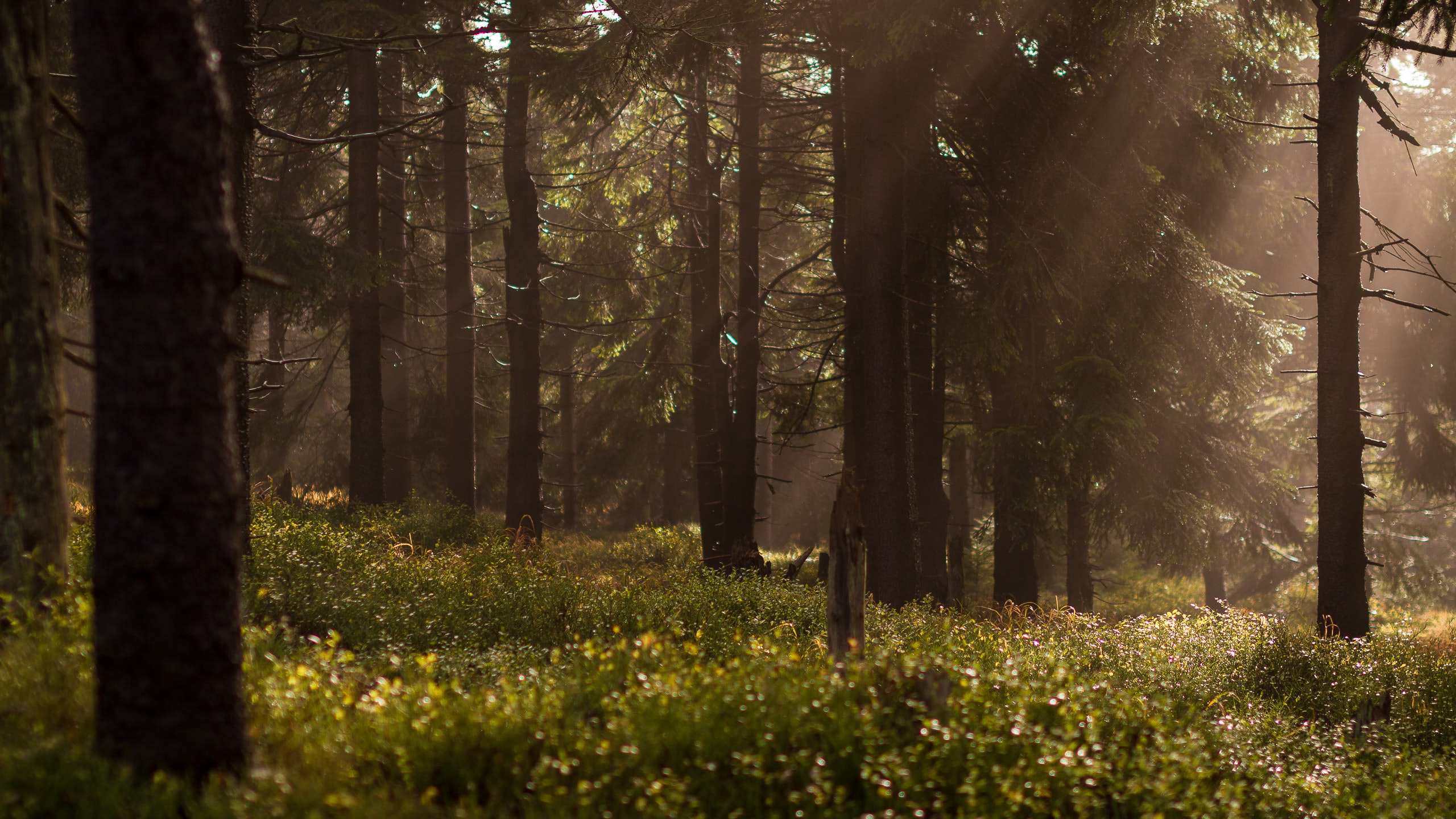
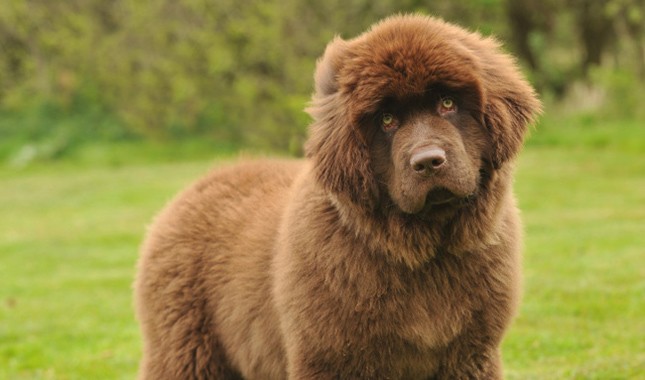
April 7. Tuesday. Went to wall:in the woods. WhenI had got half a mile or more away in the woods alone,and was sitting oil a rock, Nvas surprised to be joinedby It’s large Newfoundland dog Ranger, who hadsmelledme out and so tracked me.Would that I could add his woodcraft to my own! He would trot along before me as far as the winding wood-path allowed me to see him, and then, with the shortest possible glance over his shoulder, ascertain if I was following. At a fork in the road he would pause, look back at me, and deliberate which course I would take.
Weather changes at last to drizzling. In criticising your writing, trust your fine instinct.There are many things which we come very near ques-tioning, but do not question. When I have sent offmy manuscripts to the printer, certain objectionablesentences or expressions are sure to obtrude themselves on my attention with force, though I had not con-sciously suspected them before. My critical instinct then at once breaks the ice and comes to the surface.
All enterprises must be self-supporting, must pay for themselves. The great art of life is how to turn the surplus life of the soul into life for the body — that so the life not be a failure. For instance, a poet must sustain his body with his poetry. As is said of the merchants, in ninety-nine cases out of a hundred the life of men is a failure, and bankruptcy may be surely prophesied. You must get your living by loving.
It is worth the while to have lived a primitive wilderness life at some time, to know what are, after all, the necessaries of life and what methods society has taken to supply them. I have looked over the old day-books of the merchants with the same view, – to see what it was shopmen bought. They are the grossest groceries. Salt is perhaps the most important article in such a list, and most commonly bought at the stores, of articles commonly thought to be necessaries, – salt, sugar, molasses, cloth, etc., – by the farmer. You will see why stores or shops exist, not to furnish tea and coffee, but salt, etc. Here’s the rub, then.
I see how I could supply myself with every other article which I need, without using the shops, and to obtain this might be the fit occasion for a visit to the seashore. Yet even salt cannot strictly speaking be called a necessary of human life, since many tribes do not use it.
I had two friends. The one offered me friendship on such terms that I could not accept it, without a sense of degradation. He would not meet me on equal terms, but only be to some extent my patron. He would not come to see me, but was hurt if I did not visit him. He would not readily accept a favor, but would gladly confer one. He treated me with ceremony occasionally, though he could be simple and downright sometimes; and from time to time acted a part, treating me as if I were a distinguished stranger; was on stilts, using made words. Our relation was one long tragedy, yet I did not directly speak of it. I do not believe in complaint, nor in explanation. The whole is but too plain, alas, already. We grieve that we do not love each other, that we cannot confide in each other. I could not bring myself to speak, and so recognize an obstacle to our affection.
I had another friend, who, through a slight obtuseness, perchance, did not recognize a fact which the dignity of friendship would by no means allow me to descend so far as to speak of, and yet the inevitable effect of that ignorance was to hold us apart forever.
When I have entered the wooded hollow on the east of the Deep Cut, it is novel and pleasant to hear the sound of the dry leaves and twigs, which have so long been damp and silent, more worn and lighter than ever, crackling again under my feet, – though there is still considerable snow about, along wall-sides, etc., – and to see the holes and galleries recently made by the mice (?) in the fine withered grass of such places, the upper aralia hollow there. I see the peculiar softened blue sky of spring over the tops of the pines, and, when I am sheltered from the wind, I feel the warmer sun of the season reflected from the withered grass and twigs on the side of this elevated hollow.
A warmth begins to be reflected from the partially dried ground here and there in the sun in sheltered places, very cheering to invalids who have weak lungs, who think they may weather it till summer now. Nature is more genial to them. When the leaves on the forest floor are dried, and begin to rustle under such a sun and wind as these, the news is told to how many myriads of grubs that underlie them! When I perceive this dryness under my feet, I feel as if I had got a new sense, or rather I realize what was incredible to me before, that there is a new life in Nature beginning to awake, that her halls are being swept and prepared for a new occupant. It is whispered through all the aisles of the forest that another spring is approaching. The wood mouse listens at the mouth of his burrow, and the chickadee passes the news along.
I walk over a smooth green sea, or aequor, the sun just disappearing in the cloudless horizon, amid thousands of these flat isles as purple as the petals of a flower. It would not be more enchanting to walk amid the purple clouds of the sunset sky. And, by the way, this is but a sunset sky under our feet, produced by the same law, the same slanting rays and twilight. Here the clouds are these patches of snow or frozen vapor, and the ice is the greenish sky between them. Thus all of heaven is realized on earth. You have seen those purple fortunate isles in the sunset heavens, and that green and amber sky between them. Would you believe that you could ever walk amid those isles? You can on many a winter evening. I have done so a hundred times. The ice is a solid crystalline sky under our feet.
Whatever aid is to be derived from the use of a scientific term, we can never begin to see anything as it is so long as we remember the scientific term which always our ignorance has imposed on it. Natural objects and phenomena are in this sense forever wild and unnamed by us.
3 P. M. – Down railroad. Thermometer at 42 degrees. Warm as it is, I see a large flock of snow buntings on the railroad causeway. Their wings are white above next the body, but black or dark beyond and on the back. This produces that regular black and white effect when they fly past you. A laborer on the railroad tells me it is Candlemas Day (February 2d) to-morrow and the winter half out. “Half your wood and half your hay,” etc., etc.; and, as that day is, so will be the rest of winter.
I was surprised to find the ice in the middle of the last pond a beautiful delicate rose-color for two or three rods, deeper in spots. It reminded me of red snow, and may be the same. I tried to think it the blood of wounded muskrats, but it could not be. It extended several inches into the ice, at least, and had been spread by the flowing water recently. As for vegetable pigments, there were button-bushes in and about it. It was this delicate rose tint, with internal bluish tinges like mother-o/-pearl or the inside of a conch. It was quite conspicuous fifteen rods off, and the color of spring-cranberry juice. This beautiful blushing ice! What are we coming to?