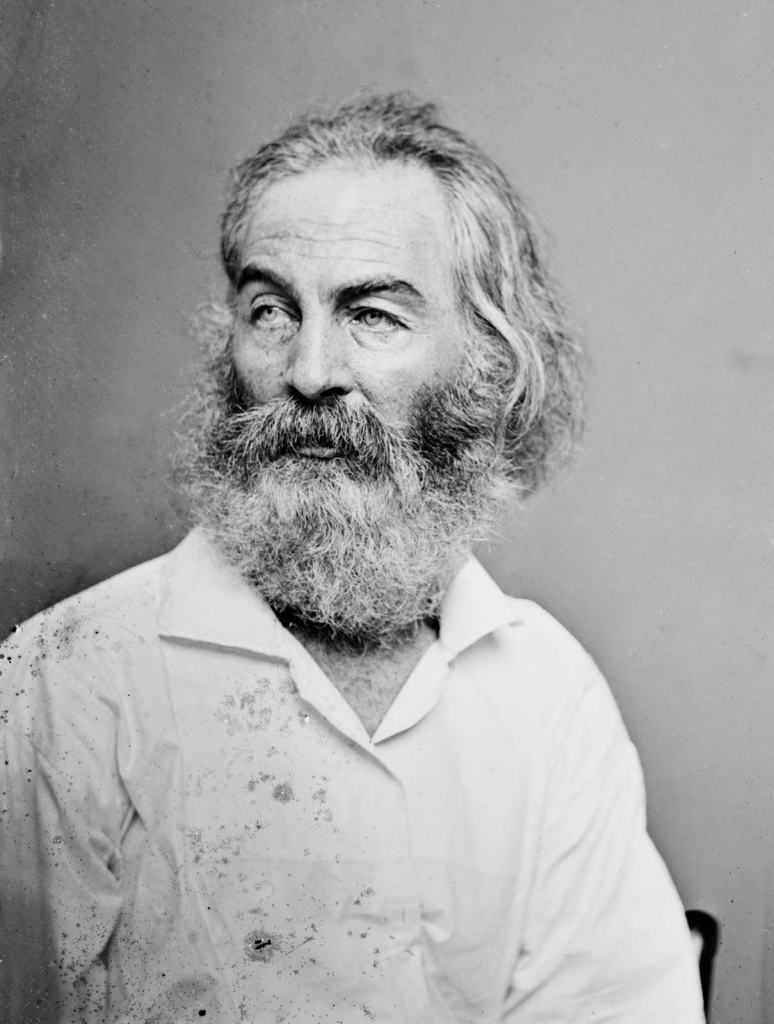
I celebrate myself, and sing myself, And what I assume you shall assume, For every atom belonging to me as good belongs to you.
I loafe and invite my soul, I lean and loafe at my ease observing a spear of summer grass.
My tongue, every atom of my blood, form’d from this soil, this air, Born here of parents born here from parents the same, and their parents the same, I, now thirty-seven years old in perfect health begin, Hoping to cease not till death.
Creeds and schools in abeyance, Retiring back a while sufficed at what they are, but never forgotten, I harbor for good or bad, I permit to speak at every hazard, Nature without check with original energy.
Lizzie (Alcott’s) family had a narrative about her, and it killed her. Not just once, but over and over again. A woman who lived and had thoughts and made art and was snarky and strange and funny and kind and suffered tremendously and died angry at the world becomes sweet, soft Beth. A dear, and nothing else. Paris Review
“If one listens to the faintest but constant suggestions of his genius, which are certainly true, he sees not to what extremes, or even insanity, it may lead him; and yet that way, as he grows more resolute and faithful, his road lies. The faintest assured objection which one healthy man feels will at length prevail over the arguments and customs of mankind.” —Walden
I find an instinct in me conducting to a mystic spiritual life, and also another to a primitive savage life.
Toward evening, as the world waxes darker, I am permitted to see the woodchuck stealing across my path, and tempted to seize and devour it. The wildest, most desolate scenes are strangely familiar to me.’
Aug15. The sounds heard at this hour, 8.30, are the distant rumbling of wagons over bridges, — farthest heard of any human at night, —the baying of dogs, the lowing of cattle in distant yards. What if we were to obey these fine dictates, these divine suggestions, which are addressed to the mind and not to the body, which are certainly true, -not to eat meat, not to buy, or sell ,or barter, etc.,etc.,etc.?
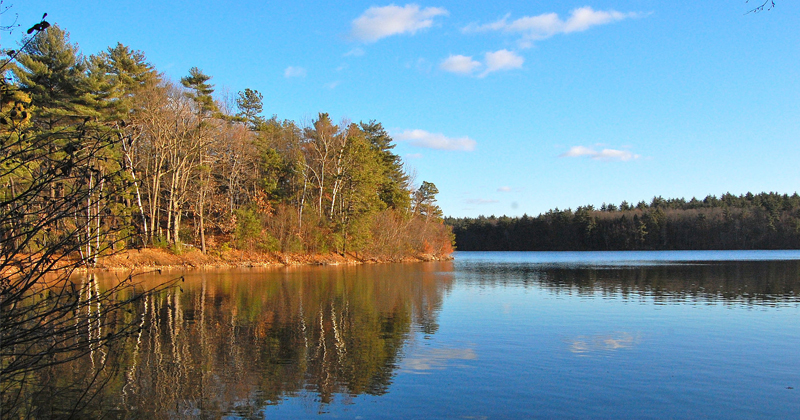
A man must find his own occasion in himself. The natural day is very calm, and will hardly reprove our indolence. If there is no elevation in our spirits, the pond will not seem elevated like a mountain tarn, but a low pool, a silent muddy water, a place for fishermen.
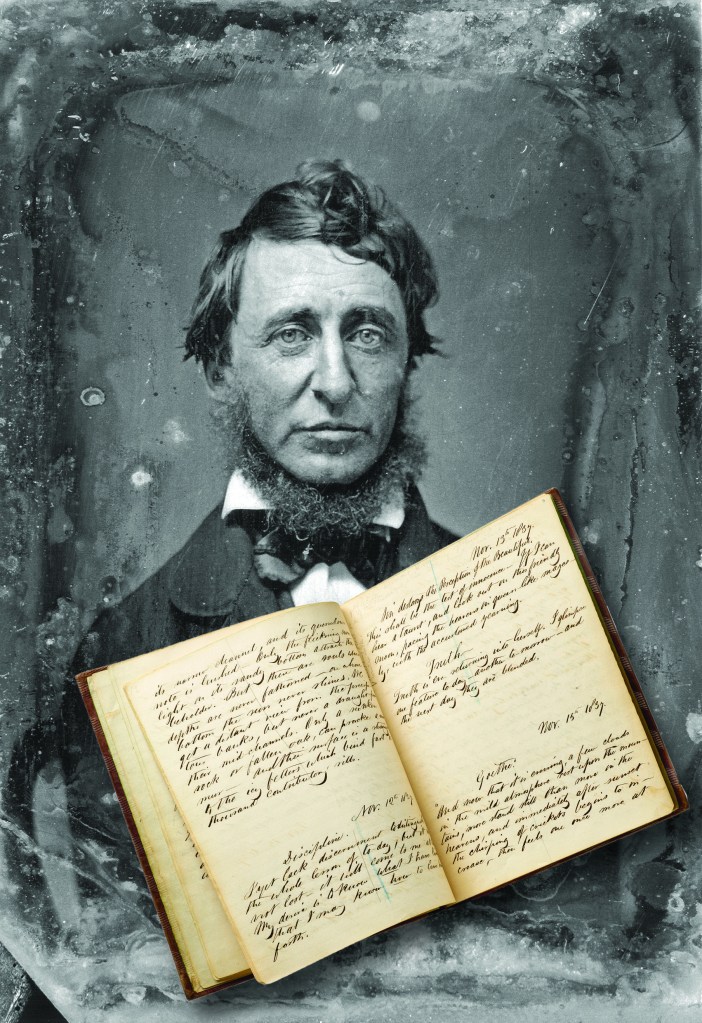
Men have become the tool of their tools. The man who independently plucked the fruits when he was hungry is become a farmer. — Journal, July 1845
“Men have become the tools of their tools. Money is not required to buy one necessity of the soul. Most of the luxuries and many of the so-called comforts of life are not only not indispensable, but positive hindrances to the elevation of mankind.” — Walden
What sweet and tender, the most innocent and divinely encouraging society there is in every natural object, and so in universal nature, even for the poor misanthrope and most melancholy man! There can be no really black melancholy to him who lives in the midst of nature and has still his senses.
July 5. Saturday . Walden . – Yesterday I came here to live. My house makes me think of some mountain houses I have seen, which seemed to have a fresher auroral atmosphere about them, as I fancy of the halls of Olympus . I lodged at the house of a saw-miller last summer, on the Catskill Mountains, high up as Pine Orchard, in the blueberry and raspberry region, where the quiet and cleanliness and coolness seemed to be all one, – which had their ambrosial character. He was the miller of the Kaaterskill Falls. They were a clean and wholesome family, inside and out, like their house. The latter was not plastered, only lathed, and the inner doors were not hung. The house seemed high-placed, airy, and perfumed, fit to entertain a traveling god. It was so high, indeed, that all the music, the broken strains, the waifs and accompaniments of tunes, that swept over the ridge of the Catskills, passed through its aisles. Could not man be man in such an abode? And would he ever find out this groveling life ‘ It was the very light and atmosphere in which the works of Grecian art were composed, and in which they rest. They have appropriated to themselves a loftier hall than mortals ever occupy, at least on a level with the mountain-brows of the world. There was wanting a little of the glare of the lower vales, and in its place a pure twilight as became the precincts of heaven. Yet so equable and calm was the season there that you could not tell whether it was morning or noon or evening. Always there was the sound of the morning cricket.
On August 31, 1837 Ralph Waldo Emerson spoke before the Phi Beta Kappa Society, at Cambridge. We know this address as The American Scholar. Oliver Wendell Holmes, Sr. would later declare this moment to be “the declaration of independence of American intellectual life.”
On July 4, 184, Emerson’s younger friend, Thoreau, would set up camp on a nook of Walden Pond to begin a two year, two month and two day experiment in consciousness and the declaration of independence his friend had offered.






 Dean’s List