Category: Thoreau-Back Thursday
Hitched To The Universe
Harold Bloom on Emerson
Recollection of Mystical Experiences” by Margaret Fuller
Walt Whitman: Song of Myself, Part 46

Part 46
I know I have the best of time and space, and was never measured and
never will be measured.I tramp a perpetual journey, (come listen all!)
My signs are a rain-proof coat, good shoes, and a staff cut from the woods,
No friend of mine takes his ease in my chair,
I have no chair, no church, no philosophy,
I lead no man to a dinner-table, library, exchange,
But each man and each woman of you I lead upon a knoll,
My left hand hooking you round the waist,
My right hand pointing to landscapes of continents and the public road.Not I, not any one else can travel that road for you,
You must travel it for yourself.It is not far, it is within reach,
Perhaps you have been on it since you were born and did not know,
Perhaps it is everywhere on water and on land.Shoulder your duds dear son, and I will mine, and let us hasten forth,
Wonderful cities and free nations we shall fetch as we go.If you tire, give me both burdens, and rest the chuff of your hand
on my hip,
And in due time you shall repay the same service to me,
For after we start we never lie by again.This day before dawn I ascended a hill and look’d at the crowded heaven,
And I said to my spirit When we become the enfolders of those orbs,
and the pleasure and knowledge of every thing in them, shall we
be fill’d and satisfied then?
And my spirit said No, we but level that lift to pass and continue beyond.You are also asking me questions and I hear you,
I answer that I cannot answer, you must find out for yourself.Sit a while dear son,
Here are biscuits to eat and here is milk to drink,
But as soon as you sleep and renew yourself in sweet clothes, I kiss you
with a good-by kiss and open the gate for your egress hence.Long enough have you dream’d contemptible dreams,
Now I wash the gum from your eyes,
You must habit yourself to the dazzle of the light and of every
moment of your life.Long have you timidly waded holding a plank by the shore,
Now I will you to be a bold swimmer,
To jump off in the midst of the sea, rise again, nod to me, shout,
and laughingly dash with your hair.
Walt Whitman – Song of the Open Road
Santayana on William James (1911)
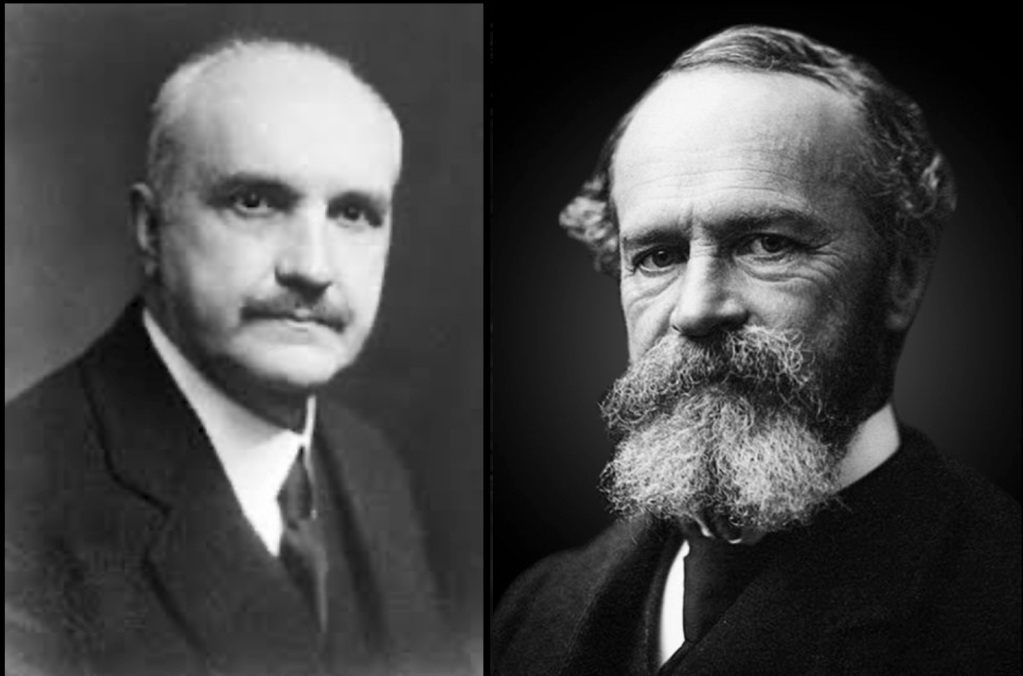
But there is another distinguished man, lately lost to this country, who has given some rude shocks to this tradition and who, as much as Whitman, may be regarded as representing the genuine, the long silent American mind — I mean William James. He and his brother Henry were as tightly swaddled in the genteel tradition as any infant geniuses could be, for they were born before 1850, and in a Swedenborgian household. Yet they burst those bands almost entirely. The ways in which the two brothers freed themselves, however, are interestingly different. Mr. Henry James has done it by adopting the point of view of the outer world, and by turning the genteel American tradition, as he turns everything else, into a subject-matter for analysis. For him it is a curious habit of mind, intimately comprehended, to be compared with other habits of mind, also well known to him. Thus he has overcome the genteel tradition in the classic way, by understanding it. With William James too this infusion of worldly insight and European sympathies was a potent influence, especially in his earlier days; but the chief source of his liberty was another. It was his personal spontaneity, similar to that of Emerson, and his personal vitality, similar to that of nobody else. Convictions and ideas came to him, so to speak, from the subsoil. He had a prophetic sympathy with the dawning sentiments of the age, with the moods of the dumb majority. His scattered words caught fire in many parts of the world. His way of thinking and feeling represented the true America, and represented in a measure the whole ultra-modern, radical world. Thus he eluded the genteel tradition in the romantic way, by continuing it into its opposite. The romantic mind, glorified in Hegel’s dialectic (which is not dialectic at all, but a sort of tragi-comic history of experience), is always rendering its thoughts unrecognisable through the infusion of new insights, and through the insensible transformation of the moral feeling that accompanies them, till at last it has completely reversed its old judgments under cover of expanding them. Thus the genteel tradition was led a merry dance when it fell again into the hands of a genuine and vigorous romanticist like William James. He restored their revolutionary force to its neutralised elements, by picking them out afresh, and emphasising them separately, according to his personal predilections.
For one thing, William James kept his mind and heart wide open to all that might seem, to polite minds, odd, personal, or visionary in religion and philosophy. He gave a sincerely respectful hearing to sentimentalists, mystics, spiritualists, wizards, cranks, quacks, and impostors — for it is hard to draw the line, and James was not willing to draw it prematurely. He thought, with his usual modesty, that any of these might have something to teach him. The lame, the halt, the blind, and those speaking with tongues could come to him with the certainty of finding sympathy; and if they were not healed, at least they were comforted, that a famous professor should take them so seriously; and they began to feel that after all to have only one leg, or one hand, or one eye, or to have three, might be in itself no less beauteous than to have just two, like the stolid majority. Thus William James became the friend and helper of those groping, nervous, half-educated, spiritually disinherited, passionately hungry individuals of which America is full. He became, at the same time, their spokesman and representative before the learned world; and he made it a chief part of his vocation to recast what the learned world has to offer, so that as far as possible it might serve the needs and interests of these people.
Yet the normal practical masculine American, too, had a friend in William James. There is a feeling abroad now, to which biology and Darwinism lend some colour, that theory is simply an instrument for practice, and intelligence merely a help toward material survival. Bears, it is said, have fur and claws, but poor naked man is condemned to be intelligent, or he will perish. This feeling William James embodied in that theory of thought and of truth which he called pragmatism. Intelligence, he thought, is no miraculous, idle faculty, by which we mirror passively any or everything that happens to be true, reduplicating the real world to no purpose. Intelligence has its roots and its issue in the context of events; it is one kind of practical adjustment, an experimental act, a form of vital tension. It does not essentially serve to picture other parts of reality, but to connect them. This view was not worked out by William James in its psychological and historical details; unfortunately he developed it chiefly in controversy against its opposite, which he called intellectualism, and which he hated with all the hatred of which his kind heart was capable. Intellectualism, as he conceived it, was pure pedantry; it impoverished and verbalised everything, and tied up nature in red tape. Ideas and rules that may have been occasionally useful it put in the place of the full-blooded irrational movement of life which had called them into being; and these abstractions, so soon obsolete, it strove to fix and to worship for ever. Thus all creeds and theories and all formal precepts sink in the estimation of the pragmatist to a local and temporary grammar of action; a grammar that must be changed slowly by time, and may be changed quickly by genius. To know things as a whole, or as they are eternally, if there is anything eternal in them, is not only beyond our powers, but would prove worthless, and perhaps even fatal to our lives. Ideas are not mirrors, they are weapons; their function is to prepare us to meet events, as future experience may unroll them. Those ideas that disappoint us are false ideas; those to which events are true are true themselves.
This may seem a very utilitarian view of the mind; and I confess I think it a partial one, since the logical force of beliefs and ideas, their truth or falsehood as assertions, has been overlooked altogether, or confused with the vital force of the material processes which these ideas express. It is an external view only, which marks the place and conditions of the mind in nature, but neglects its specific essence; as if a jewel were defined as a round hole in a ring. Nevertheless, the more materialistic the pragmatist’s theory of the mind is, the more vitalistic his theory of nature will have to become. If the intellect is a device produced in organic bodies to expedite their processes, these organic bodies must have interests and a chosen direction in their life; otherwise their life could not be expedited, nor could anything be useful to it. In other words — and this is a third point at which the philosophy of William James has played havoc with the genteel tradition, while ostensibly defending it — nature must be conceived anthropomorphically and in psychological terms. Its purposes are not to be static harmonies, self-unfolding destinies, the logic of spirit, the spirit of logic, or any other formal method and abstract law; its purposes are to be concrete endeavours, finite efforts of souls living in an environment which they transform and by which they, too, are affected. A spirit, the divine spirit as much as the human, as this new animism conceives it, is a romantic adventurer. Its future is undetermined. Its scope, its duration, and the quality of its life are all contingent. This spirit grows; it buds and sends forth feelers, sounding the depths around for such other centres of force or life as may exist there. It has a vital momentum, but no predetermined goal. It uses its past as a stepping-stone, or rather as a diving-board, but has an absolutely fresh will at each moment to plunge this way or that into the unknown. The universe is an experiment; it is unfinished. It has no ultimate or total nature, because it has no end. It embodies no formula or statable law; any formula is at best a poor abstraction, describing what, in some region and for some time, may be the most striking characteristic of existence; the law is a description a posteriori of the habit things have chosen to acquire, and which they may possibly throw off altogether. What a day may bring forth is uncertain; uncertain even to God. Omniscience is impossible; time is real; what had been omniscience hitherto might discover something more to-day. “There shall be news,” William James was fond of saying with rapture, quoting from the unpublished poem of an obscure friend, “there shall be news in heaven!” There is almost certainly, he thought, a God now; there may be several gods, who might exist together, or one after the other. We might, by our conspiring sympathies, help to make a new one. Much in us is doubtless immortal; we survive death for some time in a recognisable form; but what our career and transformations may be in the sequel we cannot tell, although we may help to determine them by our daily choices. Observation must be continual if our ideas are to remain true. Eternal vigilance is the price of knowledge; perpetual hazard, perpetual experiment keep quick the edge of life.
This is, so far as I know, a new philosophical vista; it is a conception never before presented, although implied, perhaps, in various quarters, as in Norse and even Greek mythology. It is a vision radically empirical and radically romantic; and as William James himself used to say, the visions and not the arguments of a philosopher are the interesting and influential things about him. William James, rather too generously, attributed this vision to M. Bergson, and regarded him in consequence as a philosopher of the first rank, whose thought was to be one of the turning-points in history. M. Bergson had killed intellectualism. It was his book on creative evolution, said James with humorous emphasis, that had come at last to “écraser l’infâme.” We may suspect, notwithstanding, that intellectualism, infamous and crushed, will survive the blow; and if the author of the Book of Ecclesiastes were now alive, and heard that there shall be news in heaven, he would doubtless say that there may possibly be news there, but that under the sun there is nothing new — not even radical empiricism or radical romanticism, which from the beginning of the world has been the philosophy of those who as yet had had little experience; for to the blinking little child it is not merely something in the world that is new daily, but everything is new all day. I am not concerned with the rights and wrongs of that controversy; my point is only that William James, in this genial evolutionary view of the world, has given a rude shock to the genteel tradition. What! The world a gradual improvisation? Creation unpremeditated? God a sort of young poet or struggling artist? William James is an advocate of theism; pragmatism adds one to the evidences of religion; that is excellent. But is not the cool abstract piety of the genteel getting more than it asks for? This empirical naturalistic God is too crude and positive a force; he will work miracles, he will answer prayers, he may inhabit distinct places, and have distinct conditions under which alone he can operate; he is a neighbouring being, whom we can act upon, and rely upon for specific aids, as upon a personal friend, or a physician, or an insurance company. How disconcerting! Is not this new theology a little like superstition? And yet how interesting, how exciting, if it should happen to be true! I am far from wishing to suggest that such a view seems to me more probable than conventional idealism or than Christian orthodoxy. All three are in the region of dramatic system-making and myth to which probabilities are irrelevant. If one man says the moon is sister to the sun, and another that she is his daughter, the question is not which notion is more probable, but whether either of them is at all expressive. The so-called evidences are devised afterwards, when faith and imagination have prejudged the issue. The force of William James’s new theology, or romantic cosmology, lies only in this: that it has broken the spell of the genteel tradition, and enticed faith in a new direction, which on second thoughts may prove no less alluring than the old. The important fact is not that the new fancy might possibly be true — who shall know that? — but that it has entered the heart of a leading American to conceive and to cherish it. The genteel tradition cannot be dislodged by these insurrections; there are circles to which it is still congenial, and where it will be preserved. But it has been challenged and (what is perhaps more insidious) it has been discovered. No one need be browbeaten any longer into accepting it. No one need be afraid, for instance, that his fate is sealed because some young prig may call him a dualist; the pint would call the quart a dualist, if you tried to pour the quart into him. We need not be afraid of being less profound, for being direct and sincere. The intellectual world may be traversed in many directions; the whole has not been surveyed; there is a great career in it open to talent. That is a sort of knell, that tolls the passing of the genteel tradition. Something else is now in the field; something else can appeal to the imagination, and be a thousand times more idealistic than academic idealism, which is often simply a way of white-washing and adoring things as they are. The illegitimate monopoly which the genteel tradition had established over what ought to be assumed and what ought to be hoped for has been broken down by the first-born of the family, by the genius of the race. Henceforth there can hardly be the same peace and the same pleasure in hugging the old proprieties. Hegel will be to the next generation what Sir William Hamilton was to the last. Nothing will have been disproved, but everything will have been abandoned. An honest man has spoken, and the cant of the genteel tradition has become harder for young lips to repeat.
Walt Whitman, Specimen Days
Santayana on Whitman (1911)
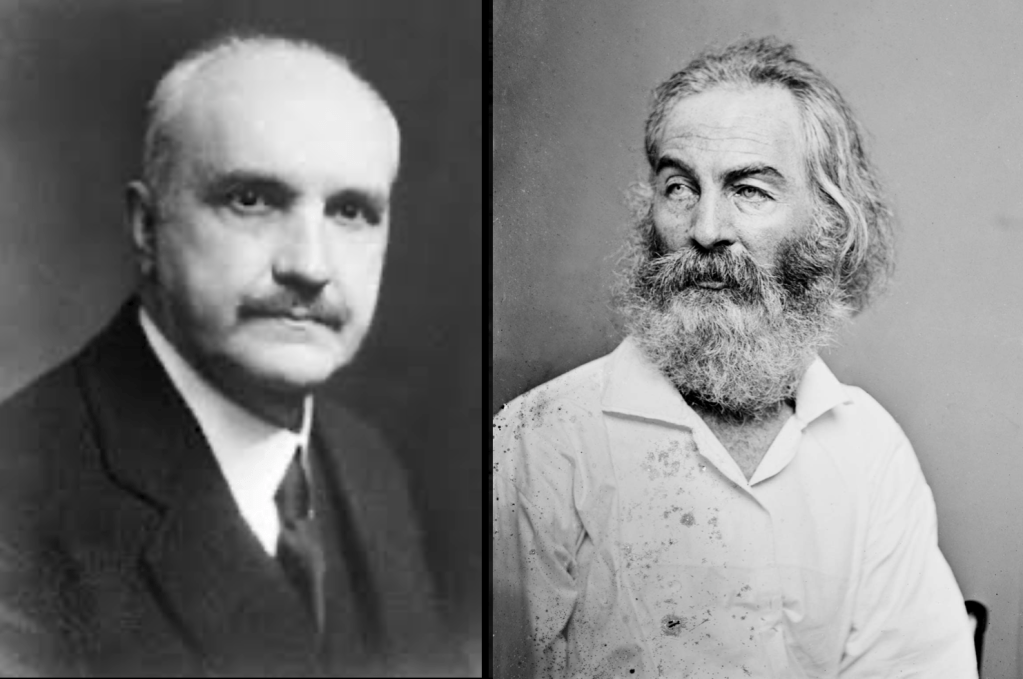
The one American writer who has left the genteel tradition entirely behind is perhaps Walt Whitman. For this reason educated Americans find him rather an unpalatable person, who they sincerely protest ought not to be taken for a representative of their culture; and he certainly should not, because their culture is so genteel and traditional. But the foreigner may sometimes think otherwise, since he is looking for what may have arisen in America to express, not the polite and conventional American mind, but the spirit and the inarticulate principles that animate the community, on which its own genteel mentality seems to sit rather lightly. When the foreigner opens the pages of Walt Whitman, he thinks that he has come at last upon something representative and original. In Walt Whitman democracy is carried into psychology and morals. The various sights, moods, and emotions are given each one vote; they are declared to be all free and equal, and the innumerable commonplace moments of life are suffered to speak like the others. Those moments formerly reputed great are not excluded, but they are made to march in the ranks with their companions — plain foot-soldiers and servants of the hour. Nor does the refusal to discriminate stop there; we must carry our principle further down, to the animals, to inanimate nature, to the cosmos as a whole. Whitman became a pantheist; but his pantheism, unlike that of the Stoics and of Spinoza, was unintellectual, lazy, and self-indulgent; for he simply felt jovially that everything real was good enough, and that he was good enough himself. In him Bohemia rebelled against the genteel tradition; but the reconstruction that alone can justify revolution did not ensue. His attitude, in principle, was utterly disintegrating; his poetic genius fell back to the lowest level, perhaps, to which it is possible for poetic genius to fall. He reduced his imagination to a passive sensorium for the registering of impressions. No element of construction remained in it, and therefore no element of penetration. But his scope was wide; and his lazy, desultory apprehension was poetical. His work, for the very reason that it is so rudimentary, contains a beginning, or rather many beginnings, that might possibly grow into a noble moral imagination, a worthy filling for the human mind. An American in the nineteenth century who completely disregarded the genteel tradition could hardly have done more.
Santayana on Emerson (1911)
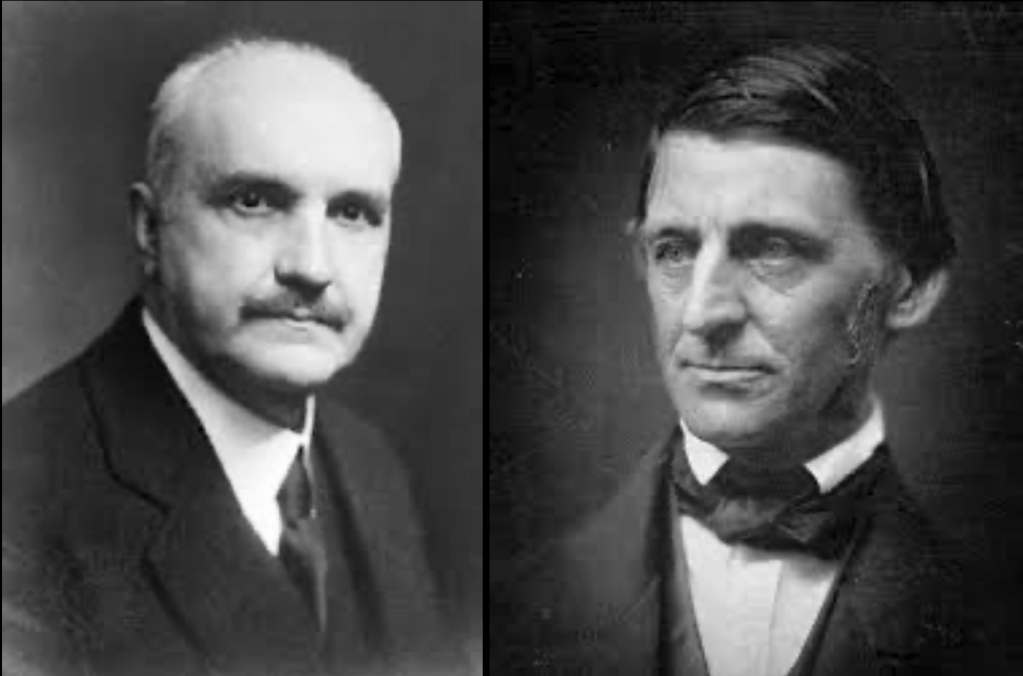
Emerson had no system; and his coveting truth had another exceptional consequence: he was detached, unworldly, contemplative. When he came out of the conventicle or the reform meeting, or out of the rapturous close atmosphere of the lecture-room, he heard Nature whispering to him: “Why so hot, little sir?” No doubt the spirit or energy of the world is what is acting in us, as the sea is what rises in every little wave; but it passes through us, and cry out as we may, it will move on. Our privilege is to have perceived it as it moves. Our dignity is not in what we do, but in what we understand. The whole world is doing things. We are turning in that vortex; yet within us is silent observation, the speculative eye before which all passes, which bridges the distances and compares the combatants. On this side of his genius Emerson broke away from all conditions of age or country and represented nothing except intelligence itself.
There was another element in Emerson, curiously combined with transcendentalism, namely, his love and respect for Nature. Nature, for the transcendentalist, is precious because it is his own work, a mirror in which he looks at himself and says (like a poet relishing his own verses), “What a genius I am! Who would have thought there was such stuff in me?” And the philosophical egotist finds in his doctrine a ready explanation of whatever beauty and commodity nature actually has. No wonder, he says to himself, that nature is sympathetic, since I made it. And such a view, one-sided and even fatuous as it may be, undoubtedly sharpens the vision of a poet and a moralist to all that is inspiriting and symbolic in the natural world. Emerson was particularly ingenious and clear-sighted in feeling the spiritual uses of fellowship with the elements. This is something in which all Teutonic poetry is rich and which forms, I think, the most genuine and spontaneous part of modern taste, and especially of American taste. Just as some people are naturally enthralled and refreshed by music, so others are by landscape. Music and landscape make up the spiritual resources of those who cannot or dare not express their unfulfilled ideals in words. Serious poetry, profound religion (Calvinism, for instance), are the joys of an unhappiness that confesses itself; but when a genteel tradition forbids people to confess that they are unhappy, serious poetry and profound religion are closed to them by that; and since human life, in its depths, cannot then express itself openly, imagination is driven for comfort into abstract arts, where human circumstances are lost sight of, and human problems dissolve in a purer medium. The pressure of care is thus relieved, without its quietus being found in intelligence. To understand oneself is the classic form of consolation; to elude oneself is the romantic. In the presence of music or landscape human experience eludes itself; and thus romanticism is the bond between transcendental and naturalistic sentiment. The winds and clouds come to minister to the solitary ego. Have there been, we may ask, any successful efforts to escape from the genteel tradition, and to express something worth expressing behind its back? This might well not have occurred as yet; but America is so precocious, it has been trained by the genteel tradition to be so wise for its years, that some indications of a truly native philosophy and poetry are already to be found. I might mention the humorists, of whom you here in California have had your share. The humorists, however, only half escape the genteel tradition; their humour would lose its savour if they had wholly escaped it. They point to what contradicts it in the facts; but not in order to abandon the genteel tradition, for they have nothing solid to put in its place. When they point out how ill many facts fit into it, they do not clearly conceive that this militates against the standard, but think it a funny perversity in the facts. Of course, did they earnestly respect the genteel tradition, such an incongruity would seem to them sad, rather than ludicrous. Perhaps the prevalence of humour in America, in and out of season, may be taken as one more evidence that the genteel tradition is present pervasively, but everywhere weak. Similarly in Italy, during the Renaissance, the Catholic tradition could not be banished from the intellect, since there was nothing articulate to take its place; yet its hold on the heart was singularly relaxed. The consequence was that humorists could regale themselves with the foibles of monks and of cardinals, with the credulity of fools, and the bogus miracles of the saints; not intending to deny the theory of the church, but caring for it so little at heart that they could find it infinitely amusing that it should be contradicted in men’s lives and that no harm should come of it. So when Mark Twain says, “I was born of poor but dishonest parents,” the humour depends on the parody of the genteel Anglo-Saxon convention that it is disreputable to be poor; but to hint at the hollowness of it would not be amusing if it did not remain at bottom one’s habitual conviction.
 Dean’s List