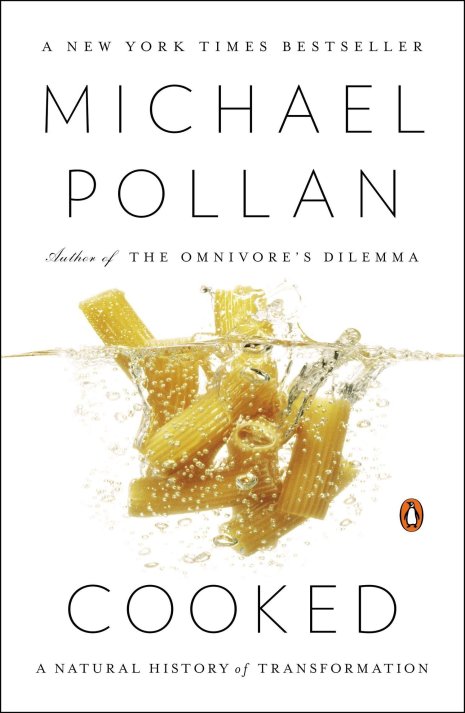
In discussing my reading through Michale Pollan’s oeuvre I have often commented on my appreciation for his four-part structure. I am happy to say that he has returned to this structure for Cooked. I must admit though it left me unsatiated. You know what I learned most listening to this book? Listening to someone talk about food and cooling for hours on end makes you hungry.
Let me explain.
Each of the four sections this book is dedicated to one of the four elements Fire, Water, Air, and Earth and how these elements are used to “cook” food. In the first section, Pollan discusses the culture and process of using fire to transform a dead hog into BBQ. I rarely eat anything “meaty” and pork is pretty much an abstract concept so the first section while sounding tasty did not make me hungry. But every other section did.
Section two (water) is on pot cookery, casseroles and braises, you can cook a lot of yummy vegetarian things in a pot. Plus all that talk of chopping and cooking yummy vegetarian things tends to get my mind going. Suddenly I am in a much nicer kitchen than I have, making something yummy and all clean up will be taken care of when my hunger-inducing daydream ends. That is not the case in reality. That is not the case in reality.
Section three (air) is about bread. I love bread! Really, who doesn’t love bread? Even people with celiac love bread. He makes bread sound so good! Celiac runs in my family and I am probably ever so slightly “on the spectrum” if that’s a thing that I have pretty much taken it out of my diet. So for me, this section was like being an addict and walking into some den of inequity — where your drug of choice was all you can eat free of charge. I was seriously contemplating starting to make my own sourdough bread until Pollan woke me from this delirium with the words “white bread.” He spends page after page reminding me of all the ways I LOVE to eat bread before he reminds me this is basically POISON. I will say that this section also convinced me of the importance of a little — just a little — locally made whole grain bread in my diet. What about the Celiac issue? As he says, it seems to be less of an issue with me with whole grain bread.
Which brings us to the fourth section (earth) about fermentation. Pollan actually ends up making beer. I have a sense of coming full circle here because I am only slightly more likely to drink beer than eat pork. I will drink a little beer, usually a sip for taste and more rarely a bottle, or part thereof, to be social. I used to love beer. But one day I realized that my family’s tendency for Celiac trumped my love of beer. Leading up to his decision to ferment beer Pollan talks reasonably in depth about the importance of eating fermented food. Was it enticing? Well, presently I am trying to figure out how to make sauerkraut. I’ll let you know how that goes.
This book will make you hungry.



 Dean’s List