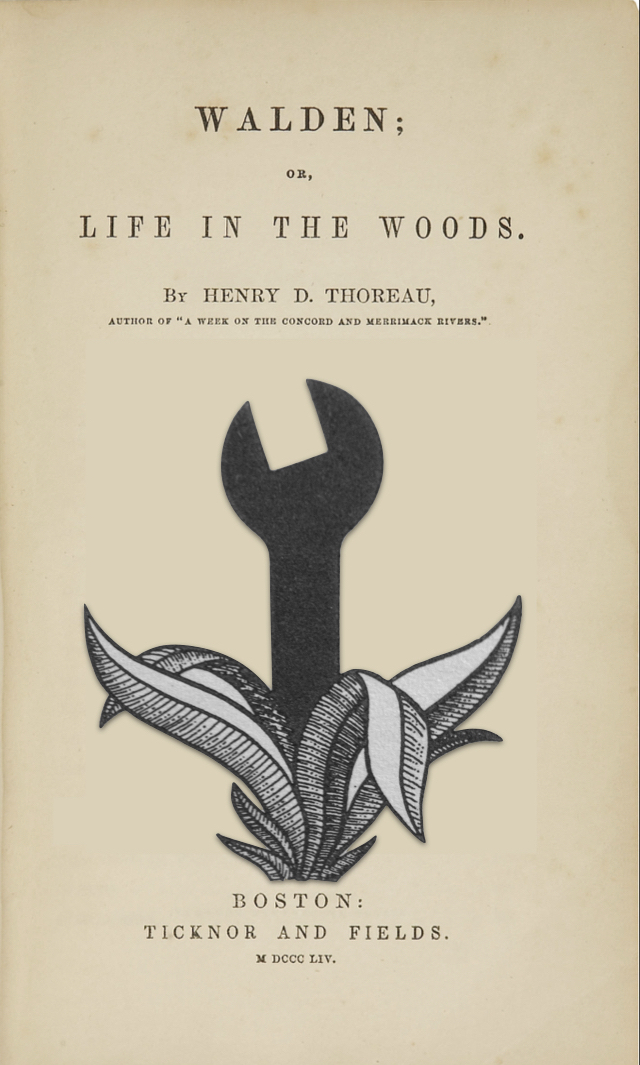
Men have become the tool of their tools. The man who independently plucked the fruits when he was hungry is become a farmer. — Journal, July 1845
“Men have become the tools of their tools. Money is not required to buy one necessity of the soul. Most of the luxuries and many of the so-called comforts of life are not only not indispensable, but positive hindrances to the elevation of mankind.” — Walden
What sweet and tender, the most innocent and divinely encouraging society there is in every natural object, and so in universal nature, even for the poor misanthrope and most melancholy man! There can be no really black melancholy to him who lives in the midst of nature and has still his senses.
July 5. Saturday . Walden . – Yesterday I came here to live. My house makes me think of some mountain houses I have seen, which seemed to have a fresher auroral atmosphere about them, as I fancy of the halls of Olympus . I lodged at the house of a saw-miller last summer, on the Catskill Mountains, high up as Pine Orchard, in the blueberry and raspberry region, where the quiet and cleanliness and coolness seemed to be all one, – which had their ambrosial character. He was the miller of the Kaaterskill Falls. They were a clean and wholesome family, inside and out, like their house. The latter was not plastered, only lathed, and the inner doors were not hung. The house seemed high-placed, airy, and perfumed, fit to entertain a traveling god. It was so high, indeed, that all the music, the broken strains, the waifs and accompaniments of tunes, that swept over the ridge of the Catskills, passed through its aisles. Could not man be man in such an abode? And would he ever find out this groveling life ‘ It was the very light and atmosphere in which the works of Grecian art were composed, and in which they rest. They have appropriated to themselves a loftier hall than mortals ever occupy, at least on a level with the mountain-brows of the world. There was wanting a little of the glare of the lower vales, and in its place a pure twilight as became the precincts of heaven. Yet so equable and calm was the season there that you could not tell whether it was morning or noon or evening. Always there was the sound of the morning cricket.
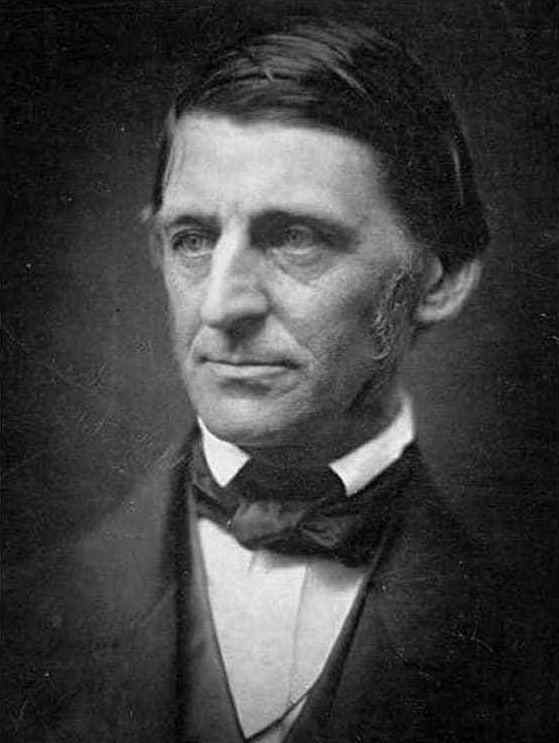
On August 31, 1837 Ralph Waldo Emerson spoke before the Phi Beta Kappa Society, at Cambridge. We know this address as The American Scholar. Oliver Wendell Holmes, Sr. would later declare this moment to be “the declaration of independence of American intellectual life.”
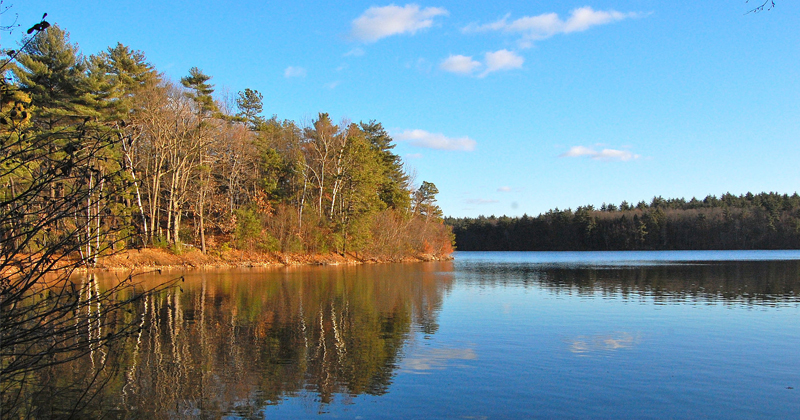
On July 4, 184, Emerson’s younger friend, Thoreau, would set up camp on a nook of Walden Pond to begin a two year, two month and two day experiment in consciousness and the declaration of independence his friend had offered.
This is June, the month of grass and leaves. The deciduous trees are investing the evergreens and revealing how dark they are. Already the aspens are trembling again, and a new summer is offered me. I feel a little fluttered in my thoughts, as if I might be too late. Each season is but an infinitesimal point. It no sooner comes than it is gone. It has no duration. It simply gives a tone and hue to my thought.
“Thoreau’s Walden… which Chris has never heard and which can be read a hundred times without exhaustion. I try always to pick a book far over his head and read it as a basis for questions and answers, rather than without interruption. I read a sentence or two, wait for him to come up with his usual barrage of questions, answer them, then read another sentence or two. Classics read well this way. They must be written this way. Sometimes we have spent a whole evening reading and talking and discovered we have only covered two or three pages. It’s a form of reading done a century ago…when Chautauquas were popular. Unless you’ve tried it you can’t imagine how pleasant it is to do it this way.”
Excerpt From: Robert M. Pirsig. “Zen and the Art of Motorcycle Maintenance.”
At length, in the beginning of May, with the help of some of my acquaintances, rather to improve so good an occasion for neighborliness than from any necessity, I setup the frame of my house. No man was evermore honored in the character of his raisers than I. They are destined, I trust, to assist at the raising of loftier structures one day. (Walden, 49)
Thoreau’s acquaintances were Ralph Waldo Emerson, A. Bronson Alcott, William Ellery Channing, George William Curtis, Burrill Curtis, Edmund Hosmer, John Hosmer, Edmund Hosmer Jr., and Andrew Hosmer. (The Days of Henry Thoreau, 181).
May 13 Where are the men who dwell in thought? Talk,—that is palaver! at which men hurrah and clap! The manners of the bear are so far good that he does not pay you any compliments.
May 14 Most men are easily transplanted from here there, for they have so little root—no tap root,—or their roots penetrate so little way, that you can thrust a shovel quite under them and take them up, roots and all.





 Dean’s List