The Botany of Desire​​

51rL+Xh+uFL._SX322_BO1,204,203,200_

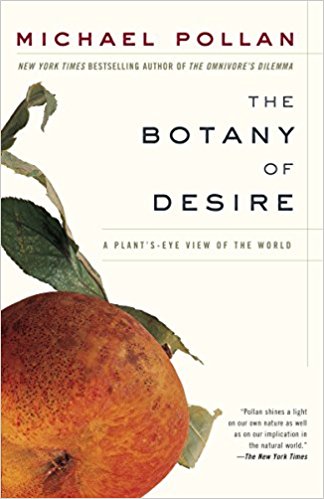
You know those authors and books you are “familiar with” but have never really read?  Pssst . . . .that is my relationship with Michael Pollan and most of his work. But thanks to the fine people at NPR and Book TV as well as his bookstore signings on YouTube I’ve always felt fairly conversant in “Pollanynesian.” But this week I am going native!  Michael Pollan has a new book coming out and I want to feel reasonably versed in his major works so I am starting with The Botany of Desire.

My first impression is really structural.  Remember how I said if I had to teach a course on the memoir I would use Wild as an instructive example.  Well, this would be my instructive example of how to write a really compelling well structured tight nonfiction book.  It’s a smart compelling read.

I have one quibble. I think he might be wrong about the term “hard cider” which he says is a 20th-century term.  I offer this because I just finished that book on Louisa May Alcott which contains the following bit from her personal journals:

“Another turn at “ Moods,” which I remodelled. From the 2d to the 25th I sat writing, with a run at dusk; could not sleep, and for three days was so full of it I could not stop to get up. Mother made me a green silk cap with a red bow, to match the old green and red party wrap, which I wore as a “ glory cloak.” Thus arrayed I sat in groves of manuscripts, “ living for immortality,” as May said. Mother wandered in and out with cordial cups of tea, worried because I could n’t eat. Father thought it fine, and brought his reddest apples and hardest cider for my Pegasus to feed upon. All sorts of fun was going on; but I didn’t care if the world returned to chaos if I and my inkstand only “lit” in the same place.”


Louisa May Alcott: The Women Behind Little​ Women

51p-Yg8QkeL._SX322_BO1,204,203,200_

I felt the need to do one more book in my accidental chick-lit series.  Many of these books have been in all or part memoir.  And in that sense, they all owe a debt to the mighty LMA!   I love Louisa May Alcott.  Now some of you may be thinking that’s just because Winona Ryder played Jo March in Little Women.  But that is not true. OK, that’s not entirely true. Let’s just agree that it is only a factor and move on.  I love her because she is amazing, brilliant, passionate, prolific and a saint.  The woman is a freaking saint!  Fun fact, since their initial publication all of Louisa May Alcott’s juvenile fiction, the March books, has ever been out of print.   Walden was initially a failure.  Moby Dick was initially a failure.  Mark Twain only wrote Tom Sawyer after how well he saw how well Little Women sold.  All and this and you can learn from this book.

Wild

wild-by-cheryl-strayed.jpg

I know it looks like I am on a “chic lit” binge at the moment, but I actually read this book a few years ago.  At that time I was binging on books about people sojourning in the woods.  This is the book that severed as dessert for that binge.  If by some seriously strange turn of events, I ever found myself responsible for teaching a course on memoir writing I would use this book. I found it all powerfully staged.  I have one major complaint about this book.  It was published six years after Eat Pray Love, and I am personally convinced her editor or somebody had the chapter added.  It’s a rather pointless chapter. But I really love this book.  I also joke every time this book is discussed that a better subtitle would be “Cheryl Makes Questionable Choices.”  Rock on oh Queen of the PCT.

Eat Pray Love

41pqc+DV-qL._SX324_BO1,204,203,200_.jpg

Oh, after finishing Big Magic I had to read this.  I have to confess that I preferred Big Magic.  I think in part that is due to Big Magic being about ideas and ways of being and this more of sentimental a memoir.  I want to go have a beverage with Richard from Texas.  I could totally hang with that guy.  I feel bad for Jose — though maybe I shouldn’t.  Maybe he got the better end of the deal.  Elizabeth — she’s complicated.


Big Magic

51fFE3o7xlL

Every so often I get stuck on what to read next.  I don’t want this. I don’t want that.  This books too heavy for my next read.  This book’s too light.  When this happens for too many days I use this ideation tool.  I go off to a torrent site and see what the people are sharing.  I just skim for something usually a title, knowing the author helps for context but I am really trying to find something, actually a few somethings, I would normally never give a chance.  My rule is to pick some titles and then go get them from the library and give them a chance.  If I don’t like my first book in a few pages or chapters I can move on to my next pick.

Obviously, this is how I found Big Magic.  I would have never ever read this book unless I forced myself to make the wild leap to read something outside my zone.  I told everyone I know who reads and even more people who don’t painters, actors, dancers, entrepreneurs to check this out.  You might want to check it out too!


The Undoing Project

undoing

I love Michale Lewis’ writing.  I think I have read every book of his but Money Ball — I did see that movie though.   In The Undoing Project, he tells the story of two amazing psychologists Amos Tversky and Daniel Kahneman.  Consider them the Lennon and McCartney of behavioral economics or “thinking about thinking,” and that’s the problem.  Like John and Paul, Amous and Danny blaze amazing trails, become super successful, and then have a falling out.  They are never as creatively powerful apart as they are together.  Of course they reunite, but of course, it’s too late.

Braving The Wilderness

51RWd4PneqL._SX329_BO1,204,203,200_

Brene Brown, like all of us, really struggles with being her authentic self.  This book, which is part memoir and part research, offers some valuable insights about braving the wilderness of authenticity.   Remember how George Bailey gets shown what the world would be like if he’d never been born in It’s A Wonderful Life. Braving The Wilderness kind of let me see a little more of what the world would be like if I wasn’t a white privileged guy totally OK with dancing to the beat of drums only I may hear.

Enlightenment​ Now​

1054996_1_01-25enlightenment_standard.png

I stopped reading this about a third of the way in.  I really enjoyed his TED Talk but in this book, he’s like the speaker who makes his point and then keeps speaking and speaking. I felt like he wasn’t just content with making his point. He wanted to settle every little intellectual score with every other position and make sure that his readers understand he is not only right but that having any other position than his was utter foolishness.

Now despite not finishing the book and not enjoying his style — both obviously subjective points of view.  I do want to share with you what is literally the last paragraph I read because I found it insightful and intriguing.  Bordering, perhaps, even on being profound.  And was the moment I knew I was better just better off putting this book down because I didn’t want him to keep going on and spoil this moment for me.

“The idea that the world is better than it was and can get better still fell out of fashion among the clerisy long ago. In The Idea of Decline in Western History, Arthur Herman shows that prophets of doom are the all-stars of the liberal arts curriculum, including Nietzsche, Arthur Schopenhauer, Martin Heidegger, Theodor Adorno, Walter Benjamin, Herbert Marcuse, Jean-Paul Sartre, Frantz Fanon, Michel Foucault, Edward Said, Cornel West, and a chorus of eco-pessimists. Surveying the intellectual landscape at the end of the 20th century, Herman lamented a “grand recessional” of “the luminous exponents” of Enlightenment humanism, the ones who believed that “since people generate conflicts and problems in society, they can also resolve them.”  Steven Pinker. “Enlightenment Now.”