Fast Company
Fungi purported to have healing properties are making their way into drinks & beauty products. Indeed, the mushroom market is expected to hit $50 billion in the coming years . . .
Stamets is adamant that with more trials currently being conducted, the greater public will eventually discover antioxidant powers of the mushroom. In fact, he is planning a clinical study on lion’s mane to further investigate its alleged ability to regenerate neurons and affect neuropathy.“It’s one of our rising stars right now,” he says of that particular mushroom. “We’re all getting older, we all face potential dementia and other neuropathy. So this is something that we’re very much focused on–these foods being beneficial.”
Enlightenment Now

I stopped reading this about a third of the way in. I really enjoyed his TED Talk but in this book, he’s like the speaker who makes his point and then keeps speaking and speaking. I felt like he wasn’t just content with making his point. He wanted to settle every little intellectual score with every other position and make sure that his readers understand he is not only right but that having any other position than his was utter foolishness.
Now despite not finishing the book and not enjoying his style — both obviously subjective points of view. I do want to share with you what is literally the last paragraph I read because I found it insightful and intriguing. Bordering, perhaps, even on being profound. And was the moment I knew I was better just better off putting this book down because I didn’t want him to keep going on and spoil this moment for me.
“The idea that the world is better than it was and can get better still fell out of fashion among the clerisy long ago. In The Idea of Decline in Western History, Arthur Herman shows that prophets of doom are the all-stars of the liberal arts curriculum, including Nietzsche, Arthur Schopenhauer, Martin Heidegger, Theodor Adorno, Walter Benjamin, Herbert Marcuse, Jean-Paul Sartre, Frantz Fanon, Michel Foucault, Edward Said, Cornel West, and a chorus of eco-pessimists. Surveying the intellectual landscape at the end of the 20th century, Herman lamented a “grand recessional” of “the luminous exponents” of Enlightenment humanism, the ones who believed that “since people generate conflicts and problems in society, they can also resolve them.” Steven Pinker. “Enlightenment Now.”
6 Ways to Exercise Self-Compassion
Yale’s Psychology and the Good Life offered for free online
(New York Times)
NEW HAVEN — On Jan. 12, a few days after registration opened at Yale for Psyc 157, Psychology and the Good Life, roughly 300 people had signed up. Within three days, the figure had more than doubled. After three more days, about 1,200 students, or nearly one-fourth of Yale undergraduates, were enrolled.The course, taught by Laurie Santos, 42, a psychology professor and the head of one of Yale’s residential colleges, tries to teach students how to lead a happier, more satisfying life in twice-weekly lectures.
“Students want to change, to be happier themselves, and to change the culture here on campus,” Dr. Santos said in an interview. “With one in four students at Yale taking it, if we see good habits, things like students showing more gratitude, procrastinating less, increasing social connections, we’re actually seeding change in the school’s culture.”
BUT WAIT!! THERE”S MORE!!! What would you pay for a course of this quality? 500 Dollars! 1000 Dollars! 10,000 Dollars! Well you can have this course for FREE!
Coursera’s rolling enrollment is here
Course Description:
“The Science of Well-Being” taught by Professor Laurie Santos overviews what psychological science says about happiness. The purpose of the course is to not only learn what psychological research says about what makes us happy but also to put those strategies into practice. The first part of the course reveals misconceptions we have about happiness and the annoying features of the mind that lead us to think the way we do. The next part of the course focuses on activities that have been proven to increase happiness along with strategies to build better habits. The last part of the course gives learners time, tips, and social support to work on the final assignment which asks learners to apply one wellness activity aka “Rewirement” into their lives for four weeks.
The Five Tibetan Rites
The Courage to Be Yourself: E.E. Cummings on Art, Life, and Being Unafraid to Feel
Brain Pickings
“To be nobody-but-yourself — in a world which is doing its best, night and day, to make you everybody else — means to fight the hardest battle which any human being can fight.”
The Neuroscience of Imagination
Everything You Ever Wanted to Know about Sensory Deprivation Tanks
Tanks For the Memories John C. Lilly
Dr. Dean’s Sabbatical of Regeneration
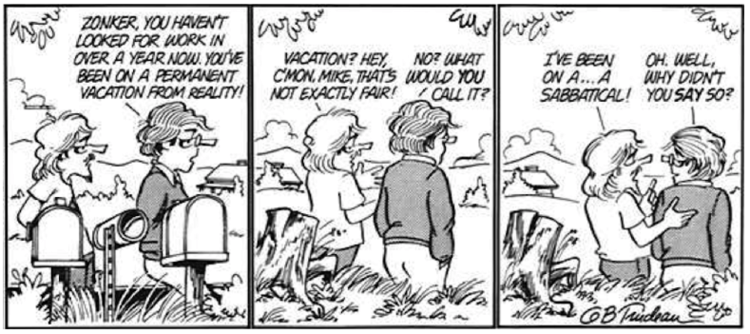
Much like young Zonker Harris, I too have been on something of a sabbatical. It was not a planned sabbatical, it sort of snuck up on me. In fact, I only realized I was on a sabbatical a few weeks ago. I was having dinner with some professor friends, one of whom was applying for an actual teaching sabbatical. During this discussion of the process is when I had the epiphany. “I’ve been on sabbatical,” I announced, pointing eagerly at my chest! “We’ve noticed,” they replied in unison. How is it they noticed? I hadn’t noticed. I hadn’t even known I’d been on sabbatical until just then. Prior to this dinner I just thought I was being distracted.
What’s been distracting me? My own advice. Actually a piece of my own advice. It’s a piece of advice I give every edition of Hacking College — you can still buy a copy. It’s a piece of advice I give in the performance by the same name. It’s a piece of advice I give privately all the time. Most of you have attended college as a means of getting a better job and more money. My advice is not to be dependent on that job or career. Jobs and careers come and go especially now and more so in the future. What you want is multiple streams of income, multiple projects of interest going at the same time.
It’s common knowledge that I have several projects going on all the time. For much of the last decade Hacking College has my main project of interest. This might be the longest any one project has held the majority of my energy and attention. A few years ago, though, it became clear to me that one of my little side projects deserved more attention. So I gave it more attention. The more attention I gave it the more interesting and rewarding it became. Slowly, without my actually noticing it, the little side project became my main project.
To be honest there is a bit of denial built into that last sentence. It’s not that I didn’t notice. It’s more honest to say that I actively worked at not noticing this process was happening. Like I said, Hacking College is the longest I have done anything, And the prospect of ending it or even not doing it full time was something of an existential crisis for me that went something like this: I’ve gotten very comfortable being the Hacking College version of Dr. Dean. And I like that guy. I like him a lot. If I’m not that guy, who am I? Who’s this other guy, this new regenerated Dr. Dean? Is he still called Dr. Dean? These and other existential questions are still being sorted.
Part of this sorting has meant weaning off Hacking College. I sought out less speaking. I posted less to this blog. I spent way less time on Facebook. None of this was by design. It was more like that the regenerated Dr. Dean and his exciting new project kept demanding more time which I gleefully gave. Also, and there may be a bit more denial going on here, I didn’t think anyone would notice. Apparently, some of you have noticed and are concerned for my well-being. Fittingly, this was brought to my attention by a former student. All is very well with the regenerating Dr. Dean. I deeply regret causing anyone a moment of needless concern for me.
I am sorry I have dropped off the face of Facebook — actually I don’t miss Facebook. People, I miss. Facebook, I don’t miss. Regenerated Dr. Dean is not into social media and very much into Internet privacy/anonymity. To that end, there may come a day when I leave social media entirely — but that day is not on the immediate horizon. Until that day, I will try to make a more regular effort to check in on Facebook. There are also a few things I would like to improve in a new edition of Hacking College that I may get to this summer. The book is in a good place and with minimal care and feeding every so often can now continue for some time. This blog however will be whenever I get around to reworking the site.
Speaking? Yeah, about that. Let’s face it, all iterations of Dr. Dean LOVE working an audience. Hacking College is such a perfect project for me because I get to research, write, build multimedia and perform. All my favorite things, all the creative gifts I was born with, expressed in one tidy package. I have no intention of letting that go entirely. If we can work it out, I’ll still come speak. Personally, I have always felt I could rock a commencement address.
I have always tried during a performance to express my deep gratitude to the schools which have brought me in to speak and the individuals in the audience who have given me their time and attention. So one more time, I do thank you.
So that’s the story of my sabbatical, or regeneration, or sabbatical for regeneration. Oh I like the sound of that, “the sabbatical for regeneration.” Oh wait, this is it: Dr. Dean’s Sabbatical of Regeneration 😉
 Dean’s List