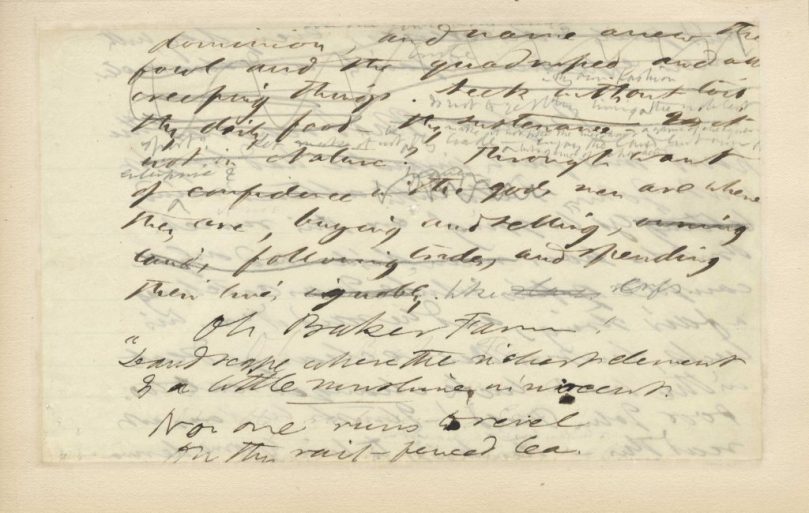
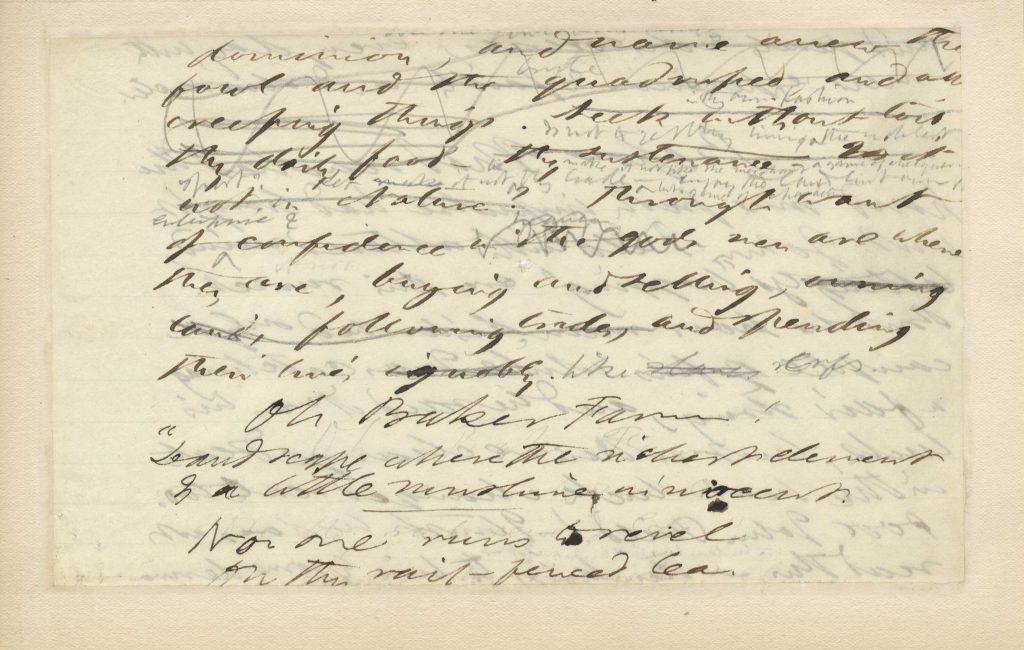
Thoreau, March 4, 1856

To Carlisle, surveying.


 I had two friends. The one offered me friendship on such terms that I could not accept it, without a sense of degradation. He would not meet me on equal terms, but only be to some extent my patron. He would not come to see me, but was hurt if I did not visit him. He would not readily accept a favor, but would gladly confer one. He treated me with ceremony occasionally, though he could be simple and downright sometimes; and from time to time acted a part, treating me as if I were a distinguished stranger; was on stilts, using made words. Our relation was one long tragedy, yet I did not directly speak of it. I do not believe in complaint, nor in explanation. The whole is but too plain, alas, already. We grieve that we do not love each other, that we cannot confide in each other. I could not bring myself to speak, and so recognize an obstacle to our affection. 


 I had another friend, who, through a slight obtuseness, perchance, did not recognize a fact which the dignity of friendship would by no means allow me to descend so far as to speak of, and yet the inevitable effect of that ignorance was to hold us apart forever. 

In Show of Bipartisanship, House Approves a Sweeping Land Conservation Bill

The House passage of the bill, on a vote of 363-62, sends the measure, which was passed by the Senate this month, to the desk of President Trump. The vote Tuesday offered a rare moment of bipartisanship in a divided chamber and a rare victory for environmentalists at a time when the Trump administration is working aggressively to strip away protections on public lands and open them to mining and drilling.

Nonetheless, Mr. Trump was expected to sign the bill into law. But the one million acres of wilderness that would be protected by the bill stand in contrast to the administration’s plans to open up for drilling nine million acres of protected habitat for the sage grouse, two million acres of protected land in Utah, parts of the vast Arctic National Wildlife Refuge in Alaska and most United States coastal waters.

New York Times

The bold print speaks for itself.

Thoreau, February 21, 1855

When I have entered the wooded hollow on the east of the Deep Cut, it is novel and pleasant to hear the sound of the dry leaves and twigs, which have so long been damp and silent, more worn and lighter than ever, crackling again under my feet, – though there is still considerable snow about, along wall-sides, etc., – and to see the holes and galleries recently made by the mice (?) in the fine withered grass of such places, the upper aralia hollow there. I see the peculiar softened blue sky of spring over the tops of the pines, and, when I am sheltered from the wind, I feel the warmer sun of the season reflected from the withered grass and twigs on the side of this elevated hollow. 


 A warmth begins to be reflected from the partially dried ground here and there in the sun in sheltered places, very cheering to invalids who have weak lungs, who think they may weather it till summer now. Nature is more genial to them. When the leaves on the forest floor are dried, and begin to rustle under such a sun and wind as these, the news is told to how many myriads of grubs that underlie them! When I perceive this dryness under my feet, I feel as if I had got a new sense, or rather I realize what was incredible to me before, that there is a new life in Nature beginning to awake, that her halls are being swept and prepared for a new occupant. It is whispered through all the aisles of the forest that another spring is approaching. The wood mouse listens at the mouth of his burrow, and the chickadee passes the news along. 

How the Natural Resources Management Act Passed

Outside

The 662-page bill is a conglomeration of some 100 pieces of legislation. Though it was largely championed by western lawmakers like senators Lisa Murkowski of Alaska and Ron Wyden of Oregon, the bill does provide conservation benefits for every state through the LWCF, which helps federal agencies, states, and local communities purchase land for parks and access to open spaces. That’s why experts believe it has been the rare issue with bipartisan agreement during the Trump administration. As with all large congressional bills, however, the National Resources Management Act is an act of compromise that leaves some wary of its effects.

Thoreau, February 12, 1860


I walk over a smooth green sea, or aequor, the sun just disappearing in the cloudless horizon, amid thousands of these flat isles as purple as the petals of a flower. It would not be more enchanting to walk amid the purple clouds of the sunset sky. And, by the way, this is but a sunset sky under our feet, produced by the same law, the same slanting rays and twilight. Here the clouds are these patches of snow or frozen vapor, and the ice is the greenish sky between them. Thus all of heaven is realized on earth. You have seen those purple fortunate isles in the sunset heavens, and that green and amber sky between them. Would you believe that you could ever walk amid those isles? You can on many a winter evening. I have done so a hundred times. The ice is a solid crystalline sky under our feet. 

Whatever aid is to be derived from the use of a scientific term, we can never begin to see anything as it is so long as we remember the scientific term which always our ignorance has imposed on it. Natural objects and phenomena are in this sense forever wild and unnamed by us.

The Senate just passed the decade’s biggest public lands package. Here’s what’s in it.

Washington Post

The bill, which the Congressional Budget Office projects would save taxpayers $9 million, enjoys broad support in the House. The lower chamber is poised to take it up after the mid-February recess, and White House officials have indicated privately that the president will sign it.
The measure protects 1.3 million acres as wilderness, the nation’s most stringent protection, which prohibits even roads and motorized vehicles. It permanently withdraws more than 370,000 acres of land from mining around two national parks, including Yellowstone, and permanently authorizes a program to spend offshore-drilling revenue on conservation efforts.

This is even more amazing then Mitch McConnell’s efforts to legalize hemp.

Thoreau, February 2, 1854

The scream of the jay is a true winter sound. It is wholly without sentiment, and in harmony with winter. I stole up within five or six feet of a pitch pine behind which a downy woodpecker was pecking. From time to time he hopped round to the side and observed me without fear. They are very confident birds, not easily scared, but incline to keep the other side of the bough to you, perhaps.

Thoreau, February 1, 1857

3 P. M. – Down railroad.
Thermometer at 42 degrees. Warm as it is, I see a large flock of snow buntings on the railroad causeway. Their wings are white above next the body, but black or dark beyond and on the back. This produces that regular black and white effect when they fly past you. 
A laborer on the railroad tells me it is Candlemas Day (February 2d) to-morrow and the winter half out. “Half your wood and half your hay,” etc., etc.; and, as that day is, so will be the rest of winter.