Thoreau on June

Thoreau’s Journal: June 6, 1857

This is June, the month of grass and leaves. The deciduous trees are investing the evergreens and revealing how dark they are. Already the aspens are trembling again, and a new summer is offered me. I feel a little fluttered in my thoughts, as if I might be too late. Each season is but an infinitesimal point. It no sooner comes than it is gone. It has no duration. It simply gives a tone and hue to my thought.

Wal-Zen

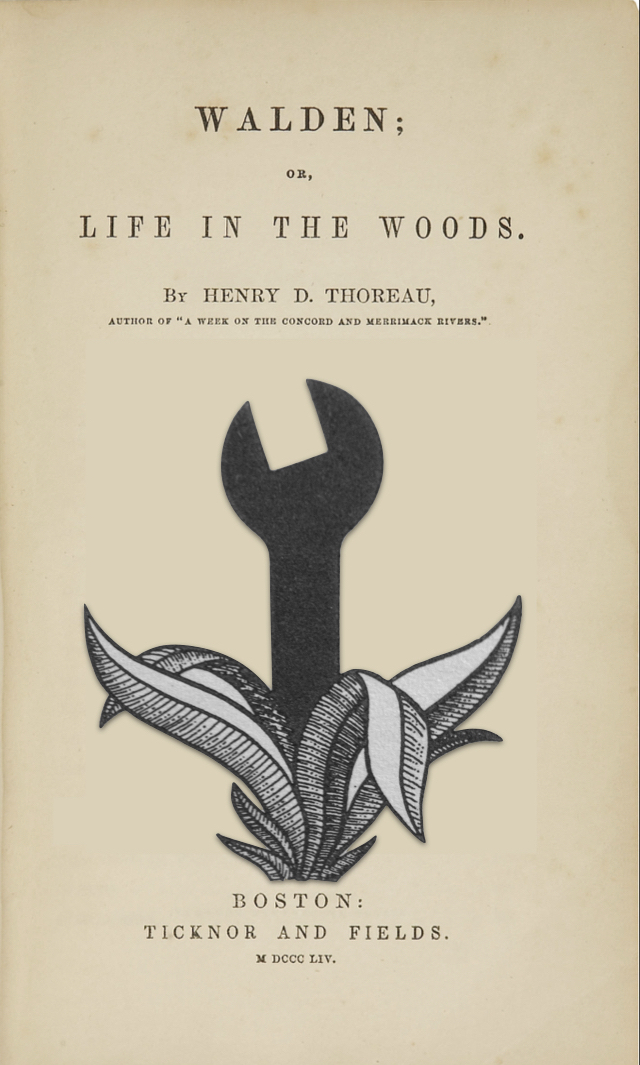
“Thoreau’s Walden… which Chris has never heard and which can be read a hundred times without exhaustion. I try always to pick a book far over his head and read it as a basis for questions and answers, rather than without interruption. I read a sentence or two, wait for him to come up with his usual barrage of questions, answer them, then read another sentence or two. Classics read well this way. They must be written this way. Sometimes we have spent a whole evening reading and talking and discovered we have only covered two or three pages. It’s a form of reading done a century ago…when Chautauquas were popular. Unless you’ve tried it you can’t imagine how pleasant it is to do it this way.”

Excerpt From: Robert M. Pirsig. “Zen and the Art of Motorcycle
Maintenance.”

Framing Walden

At length, in the beginning of May, with the help of some of my acquaintances, rather to improve so good an occasion for neighborliness than from any necessity, I setup the frame of my house. No man was evermore honored in the character of his raisers than I. They are destined, I trust, to assist at the raising of loftier structures one day. (Walden, 49)

Thoreau’s acquaintances were Ralph Waldo Emerson, A. Bronson Alcott, William Ellery Channing, George William Curtis, Burrill Curtis, Edmund Hosmer, John Hosmer, Edmund Hosmer Jr., and Andrew Hosmer.
(The Days of Henry Thoreau, 181).

Walden Woods Project

Thoreau, May 14 and 15, 1852

May 13
Where are the men who dwell in thought? Talk,—that is palaver! at which men hurrah and clap! The manners of the bear are so far good that he does not pay you any compliments.

May 14
Most men are easily transplanted from here there, for they have so little root—no tap root,—or their roots penetrate so little way, that you can thrust a shovel quite under them and take them up, roots and all.

Thoreau, May 6, 1854

“There is no such thing as pure objective observation. Your observation, to be interesting, i.e. to be significant, must be subjective. The sum of what the writer of whatever class has to report is simply some human experience…. The man of most science is the man most alive. (May 6, 1854)”