Maybe not in our hearts, but certainly in our brains. Plus, they can make you love the indoors far too much—which is why there’s now a full-fledged, woodsy rehab center for joystick addicts who need a soothing pathway back to a normal life. (Outside Online)
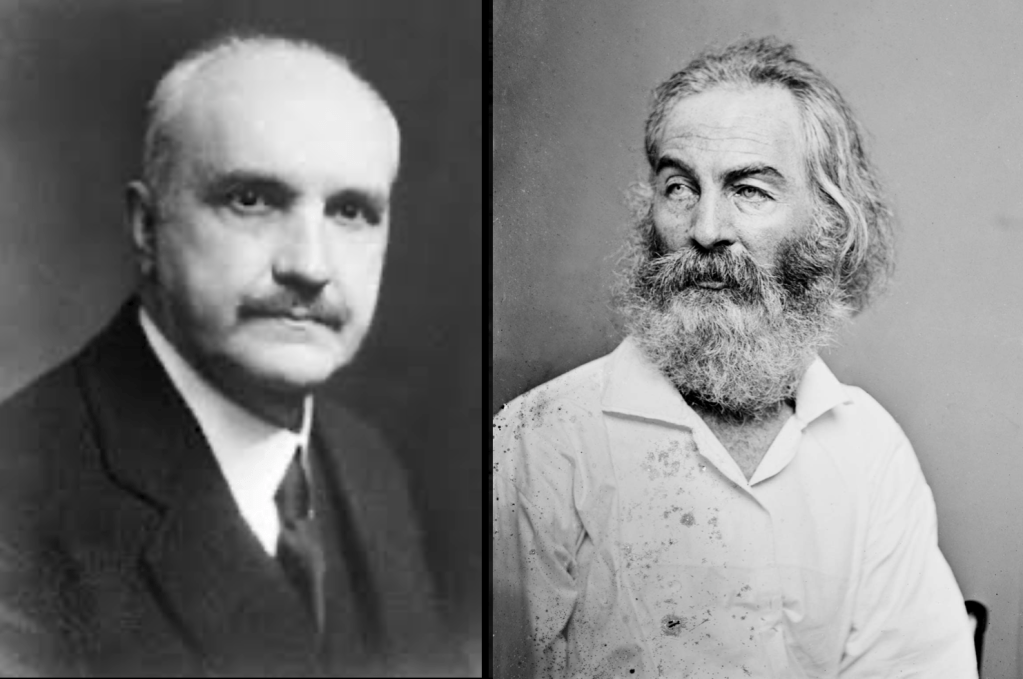
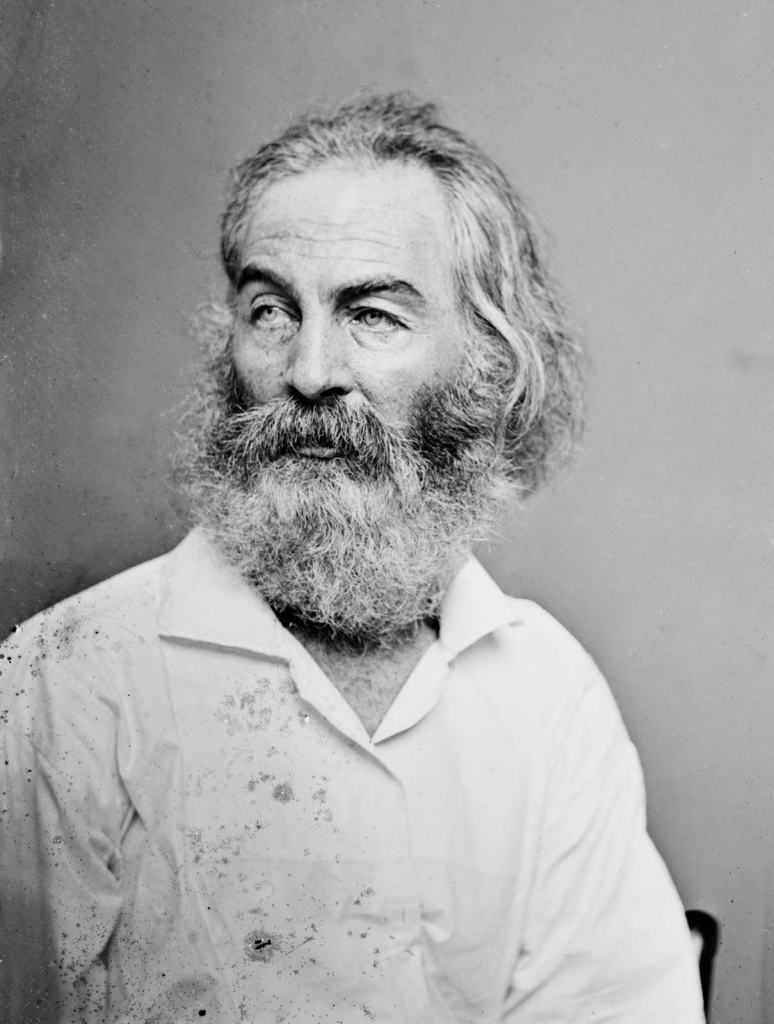
The one American writer who has left the genteel tradition entirely behind is perhaps Walt Whitman. For this reason educated Americans find him rather an unpalatable person, who they sincerely protest ought not to be taken for a representative of their culture; and he certainly should not, because their culture is so genteel and traditional. But the foreigner may sometimes think otherwise, since he is looking for what may have arisen in America to express, not the polite and conventional American mind, but the spirit and the inarticulate principles that animate the community, on which its own genteel mentality seems to sit rather lightly. When the foreigner opens the pages of Walt Whitman, he thinks that he has come at last upon something representative and original. In Walt Whitman democracy is carried into psychology and morals. The various sights, moods, and emotions are given each one vote; they are declared to be all free and equal, and the innumerable commonplace moments of life are suffered to speak like the others. Those moments formerly reputed great are not excluded, but they are made to march in the ranks with their companions — plain foot-soldiers and servants of the hour. Nor does the refusal to discriminate stop there; we must carry our principle further down, to the animals, to inanimate nature, to the cosmos as a whole. Whitman became a pantheist; but his pantheism, unlike that of the Stoics and of Spinoza, was unintellectual, lazy, and self-indulgent; for he simply felt jovially that everything real was good enough, and that he was good enough himself. In him Bohemia rebelled against the genteel tradition; but the reconstruction that alone can justify revolution did not ensue. His attitude, in principle, was utterly disintegrating; his poetic genius fell back to the lowest level, perhaps, to which it is possible for poetic genius to fall. He reduced his imagination to a passive sensorium for the registering of impressions. No element of construction remained in it, and therefore no element of penetration. But his scope was wide; and his lazy, desultory apprehension was poetical. His work, for the very reason that it is so rudimentary, contains a beginning, or rather many beginnings, that might possibly grow into a noble moral imagination, a worthy filling for the human mind. An American in the nineteenth century who completely disregarded the genteel tradition could hardly have done more.
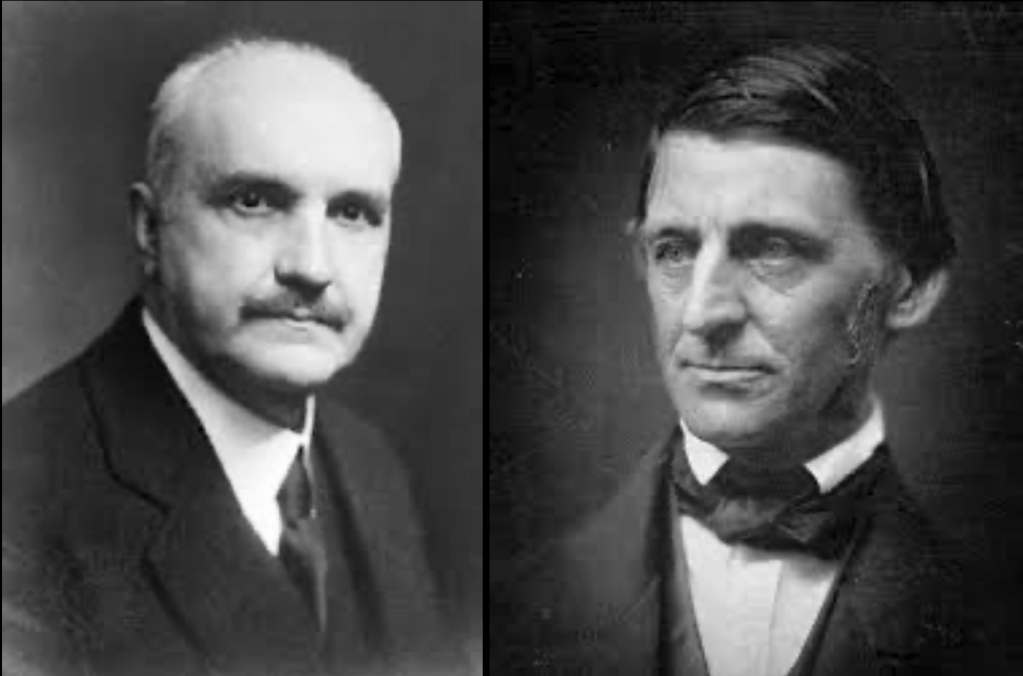
Emerson had no system; and his coveting truth had another exceptional consequence: he was detached, unworldly, contemplative. When he came out of the conventicle or the reform meeting, or out of the rapturous close atmosphere of the lecture-room, he heard Nature whispering to him: “Why so hot, little sir?” No doubt the spirit or energy of the world is what is acting in us, as the sea is what rises in every little wave; but it passes through us, and cry out as we may, it will move on. Our privilege is to have perceived it as it moves. Our dignity is not in what we do, but in what we understand. The whole world is doing things. We are turning in that vortex; yet within us is silent observation, the speculative eye before which all passes, which bridges the distances and compares the combatants. On this side of his genius Emerson broke away from all conditions of age or country and represented nothing except intelligence itself.
There was another element in Emerson, curiously combined with transcendentalism, namely, his love and respect for Nature. Nature, for the transcendentalist, is precious because it is his own work, a mirror in which he looks at himself and says (like a poet relishing his own verses), “What a genius I am! Who would have thought there was such stuff in me?” And the philosophical egotist finds in his doctrine a ready explanation of whatever beauty and commodity nature actually has. No wonder, he says to himself, that nature is sympathetic, since I made it. And such a view, one-sided and even fatuous as it may be, undoubtedly sharpens the vision of a poet and a moralist to all that is inspiriting and symbolic in the natural world. Emerson was particularly ingenious and clear-sighted in feeling the spiritual uses of fellowship with the elements. This is something in which all Teutonic poetry is rich and which forms, I think, the most genuine and spontaneous part of modern taste, and especially of American taste. Just as some people are naturally enthralled and refreshed by music, so others are by landscape. Music and landscape make up the spiritual resources of those who cannot or dare not express their unfulfilled ideals in words. Serious poetry, profound religion (Calvinism, for instance), are the joys of an unhappiness that confesses itself; but when a genteel tradition forbids people to confess that they are unhappy, serious poetry and profound religion are closed to them by that; and since human life, in its depths, cannot then express itself openly, imagination is driven for comfort into abstract arts, where human circumstances are lost sight of, and human problems dissolve in a purer medium. The pressure of care is thus relieved, without its quietus being found in intelligence. To understand oneself is the classic form of consolation; to elude oneself is the romantic. In the presence of music or landscape human experience eludes itself; and thus romanticism is the bond between transcendental and naturalistic sentiment. The winds and clouds come to minister to the solitary ego. Have there been, we may ask, any successful efforts to escape from the genteel tradition, and to express something worth expressing behind its back? This might well not have occurred as yet; but America is so precocious, it has been trained by the genteel tradition to be so wise for its years, that some indications of a truly native philosophy and poetry are already to be found. I might mention the humorists, of whom you here in California have had your share. The humorists, however, only half escape the genteel tradition; their humour would lose its savour if they had wholly escaped it. They point to what contradicts it in the facts; but not in order to abandon the genteel tradition, for they have nothing solid to put in its place. When they point out how ill many facts fit into it, they do not clearly conceive that this militates against the standard, but think it a funny perversity in the facts. Of course, did they earnestly respect the genteel tradition, such an incongruity would seem to them sad, rather than ludicrous. Perhaps the prevalence of humour in America, in and out of season, may be taken as one more evidence that the genteel tradition is present pervasively, but everywhere weak. Similarly in Italy, during the Renaissance, the Catholic tradition could not be banished from the intellect, since there was nothing articulate to take its place; yet its hold on the heart was singularly relaxed. The consequence was that humorists could regale themselves with the foibles of monks and of cardinals, with the credulity of fools, and the bogus miracles of the saints; not intending to deny the theory of the church, but caring for it so little at heart that they could find it infinitely amusing that it should be contradicted in men’s lives and that no harm should come of it. So when Mark Twain says, “I was born of poor but dishonest parents,” the humour depends on the parody of the genteel Anglo-Saxon convention that it is disreputable to be poor; but to hint at the hollowness of it would not be amusing if it did not remain at bottom one’s habitual conviction.
I celebrate myself, and sing myself, And what I assume you shall assume, For every atom belonging to me as good belongs to you.
I loafe and invite my soul, I lean and loafe at my ease observing a spear of summer grass.
My tongue, every atom of my blood, form’d from this soil, this air, Born here of parents born here from parents the same, and their parents the same, I, now thirty-seven years old in perfect health begin, Hoping to cease not till death.
Creeds and schools in abeyance, Retiring back a while sufficed at what they are, but never forgotten, I harbor for good or bad, I permit to speak at every hazard, Nature without check with original energy.





 Dean’s List