Rewilding the American Child​​

(Outside)

Unknown.jpeg

Children are much more likely to enjoy outdoor activities—and stick with them—if they start out at the right moment in their physical and cognitive development.

This months Outside contains more than a dozen articles about”Rewilding the American Child” but that is not what this site is about. It’s about cataloging and sharing good resources. It’s definitely not about click​ bate. I have not read through all of these articles yet. As I do I will be adding links below. My addition of a link only means I have read it and it has something​ to offer to my larger project. ALL of the articles are available​ here.

Kids are so over-scheduled that doctors are being told to prescribe play

IMG_7547.jpg
(Quartz)

“Play is not frivolous,” the report says. Rather, research shows that play helps children develop language and executive functioning skills, learn to negotiate with others and manage stress, and figure out how to pursue their goals while ignoring distractions, among other things. The report warns that parents and schools are focusing on academic achievement at the expense of play, and recommends that pediatricians attempt to turn the tide by prescribing play during well visits for children.

“At a time when early childhood programs are pressured to add more didactic components and less playful learning, pediatricians can play an important role in emphasizing the role of a balanced curriculum that includes the importance of playful learning for the promotion of healthy child development,” write the authors, led by Michael Yogman, chairman of the AAP committee on psychosocial aspects of child family health.

‘Risky’ Playgrounds Are Making a Comeback

(CityLab)

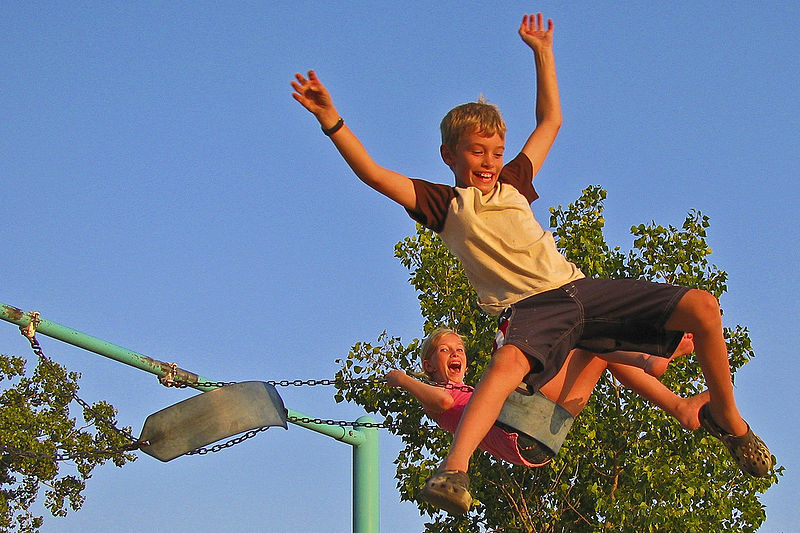
800px-Jack_and_Elise_jumping_off_swings.jpg

“The take-home message for municipalities is: Stop setting your bar at the level of the most anxious parent. If you do that, you’re guaranteed to produce boring and dull playgrounds,” said Tim Gill, a London-based researcher and advocate who recently authored a white paper on faulty assumptions about risky playgrounds. “If you set your bar at the level of the average parent or maybe even at the level of the parents … who do want some more excitement and challenge in their kids’ lives, then, things start to look different.”

Go Outside And​ Play!

Communing with the Forest Bathers

(Outside)

IMG_7623.jpg

The 30th gathering of the San Francisco–based Forest Bathing Club occurred on a Sunday afternoon in the Presidio, the city’s gorgeous 1,500-acre military post turned national park. The group first convened in 2015 and has lately ramped up to four or five events each month.

I try to saunter in nature every day.

Treating Teens’ Depression May Be Great for Parents’ Mental Health, Too

“Relationships are reciprocal,” says Laura Mufson, the associate director of the Division of Child & Adolescent Psychiatry at Columbia University, who was not involved in the study. “If one child isn’t doing well, if they’re having mood problems, if they’re more irritable—it’s affecting their behavior that impacts the rest of people in the family.”

It’s as if everything is interconnected?
Also, try time in the woods together.

Reading Aloud to Young Children Has Benefits for Behavior and Attention

(New York Times)

It’s a truism in child development that the very young learn through relationships and back-and-forth interactions, including the interactions that occur when parents read to their children. A new study provides evidence of just how sustained an impact reading and playing with young children can have, shaping their social and emotional development in ways that go far beyond helping them learn language and early literacy skills. The parent-child-book moment even has the potential to help curb problem behaviors like aggression, hyperactivity and difficulty with attention, a new study has found.

The Happiness​ Project

1443414565

This is a perfectly enjoyable and enriching book. One of her first insights is to just let herself be herself.  It’s a principal she  calls “just be Gretchen.” Don’t try to be this idealized version who you think you should be.  Don’t try to force yourself to like Jazz or Opera because your “sophisticated” just like what you like and be who you are authentically.  I kept thinking Brene’ Brown should really read this book!

Yale’s Psychology and the Good Life offered for free online

(New York Times)
NEW HAVEN — On Jan. 12, a few days after registration opened at Yale for Psyc 157, Psychology and the Good Life, roughly 300 people had signed up. Within three days, the figure had more than doubled. After three more days, about 1,200 students, or nearly one-fourth of Yale undergraduates, were enrolled.

The course, taught by Laurie Santos, 42, a psychology professor and the head of one of Yale’s residential colleges, tries to teach students how to lead a happier, more satisfying life in twice-weekly lectures.

“Students want to change, to be happier themselves, and to change the culture here on campus,” Dr. Santos said in an interview. “With one in four students at Yale taking it, if we see good habits, things like students showing more gratitude, procrastinating less, increasing social connections, we’re actually seeding change in the school’s culture.”

BUT WAIT!! THERE”S MORE!!! What would you pay for a course of this quality?  500 Dollars!  1000 Dollars! 10,000 Dollars!  Well you can have this course for FREE!

Coursera’s rolling enrollment is here

Course Description:
“The Science of Well-Being” taught by Professor Laurie Santos overviews what psychological science says about happiness. The purpose of the course is to not only learn what psychological research says about what makes us happy but also to put those strategies into practice. The first part of the course reveals misconceptions we have about happiness and the annoying features of the mind that lead us to think the way we do. The next part of the course focuses on activities that have been proven to increase happiness along with strategies to build better habits. The last part of the course gives learners time, tips, and social support to work on the final assignment which asks learners to apply one wellness activity aka “
Rewirement” into their lives for four weeks.