Deep Agriculture
In the midst of the Michael Cohen/Paul Manafort/Donald Trump news bonanza this week, some important news got buried. Okay, the Trump news isn’t unimportant, but we’re talking “important” in terms of the long-term survival of the human race in the face of climate change. And recent signs from the Arctic shows that those chances of surviving aren’t great. Here’s what’s going on
Hint: It’s not good!
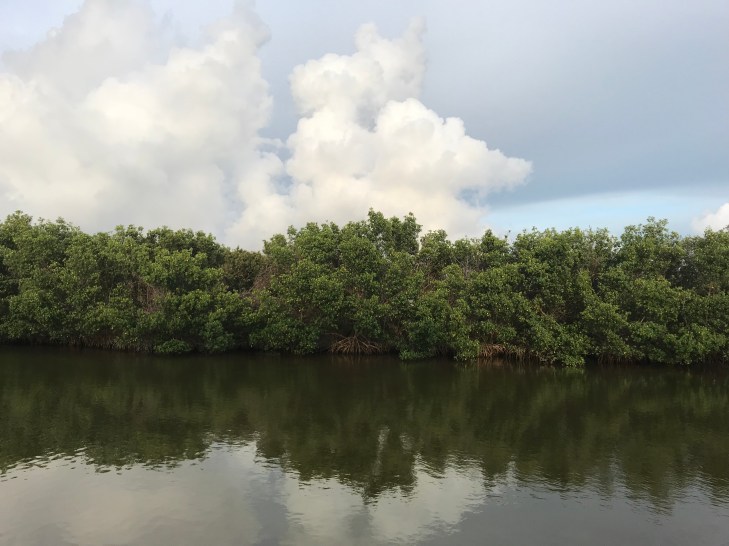
The 30th gathering of the San Francisco–based Forest Bathing Club occurred on a Sunday afternoon in the Presidio, the city’s gorgeous 1,500-acre military post turned national park. The group first convened in 2015 and has lately ramped up to four or five events each month.
I try to saunter in nature every day.

(Undark.org)
I expressed the first serious concern about the potential health consequences of electric light at night 30 years ago, when I asked whether over-lighting might increase the risk of breast cancer. It was during the 1980s, just as researchers were finding that a fatty Western diet might not much alter the breast-cancer risk in individuals, that a friend from the Fred Hutchinson Cancer Research Center in Seattle pointed me to research on the impact of melatonin. Lowered levels of melatonin (an effect of over-lighting) had been traced to heightened levels of oestrogen (at least in rodents), a clear breast-cancer risk factor when fatty diets were not. Later evidence has shown that women who work the night shift are at higher breast-cancer risk. Evidence suggests that circadian disruption from over-lighting the night could be related to risk of obesity and depression as well. In fact, it might be that virtually all aspects of health and wellbeing are dependent to one extent or another on a synchronized circadian rhythmicity, with a natural cycle of bright days and dark nights.
This makes me very happy about preference for a firelight level of light at night.
Putting a finer point on the risk is ‘The New World Atlas of Artificial Night Sky Brightness’, published in 2016. The atlas uses data from NASA’s Suomi National Polar-orbiting Partnership satellite to estimate skyglow across the globe. The images in the atlas are either dazzling or horrifying, depending on how you look at it. In its colored maps of cities and countries, using brighter colors to show greater skyglow, Europe and North America appear ablaze. According to the atlas, the Milky Way cannot be seen at night by one-third of humans. In Europe, it’s not visible to 60 percent of people, and in North America, it’s a whopping 80 percent.
That would be me.
“Relationships are reciprocal,” says Laura Mufson, the associate director of the Division of Child & Adolescent Psychiatry at Columbia University, who was not involved in the study. “If one child isn’t doing well, if they’re having mood problems, if they’re more irritable—it’s affecting their behavior that impacts the rest of people in the family.”
It’s as if everything is interconnected?
Also, try time in the woods together.

(Wired)
SOMETIMES VIKKI PRESTON is inching her way through the forest when she comes across a grove of tan oak trees that feels special. The plants are healthy, the trees are old, and their trunks are nicely spaced out on the forest floor. “You can feel that the grove has been taken care of,” she says. “There’s been a lot of love and thoughtfulness.”
I bow to you.
Editor’s Note
This narrative by Nathaniel Rich is a work of history, addressing the 10-year period from 1979 to 1989: the decisive decade when humankind first came to a broad understanding of the causes and dangers of climate change. Complementing the text is a series of aerial photographs and videos, all shot over the past year by George Steinmetz. With support from the Pulitzer Center, this two-part article is based on 18 months of reporting and well over a hundred interviews. It tracks the efforts of a small group of American scientists, activists and politicians to raise the alarm and stave off catastrophe. It will come as a revelation to many readers — an agonizing revelation — to understand how thoroughly they grasped the problem and how close they came to solving it. Jake Silverstein
Dean’s Note
This is heartbreaking
Look at Mother Nature on the run in the 21st century.
(Gizmodo)
After years of painstaking acoustic measurements, Hempton identified this spot on Washington’s Olympic Peninsula as the quietest place in the U.S.—the spot most free of our man-made noise pollution. He has nurtured this square inch, guided people to it, and protected it from encroaching cacophony of our modern world. But now it faces its biggest threat yet.
 Dean’s List