
“There is no such thing as pure objective observation. Your observation, to be interesting, i.e. to be significant, must be subjective. The sum of what the writer of whatever class has to report is simply some human experience…. The man of most science is the man most alive. (May 6, 1854)”
Author: Dr. Dean
Walking on sunshine
Rupert Sheldrake. Ways To Go Beyond and Why They Work. 27.02.19
Thoreau, May 5, 1838

Each one’s world is but a clearing in the forest, so much open and inclused ground. When the mail coach rumbles into one of these, the villagers gaze after you with a compassionate look, as much as to say: “Where have you been all this time, that you make your debut in the world at this late hour? Nevertheless, here we are; come and study us, that you may learn men and manners.
5/1/19
Thoreau, April 24, 1859

There is a season for everything, and we do not notice a given phenomenon at any other season, if, indeed, it can be called the same phenomenon at any other season. There is a time to watch the ripples on Ripple Lake, to look for arrowheads, to study the rocks and lichens, a time to walk on sandy deserts; and the observer of nature must improve these seasons as much as the farmer his. So boys fly kites and play ball or hawkie at particular times all over the State. A wise man will know what game to play to-day, and play it.
4/24/19
Thoreau, April 15, 1858

The naturalist accomplishes a great deal by patience, more perhaps than by activity. He must take his position, and then wait and watch. It is equally true of quadrupeds and reptiles. Sit still in the midst of their haunts.
Thoreau, April 15, 1851
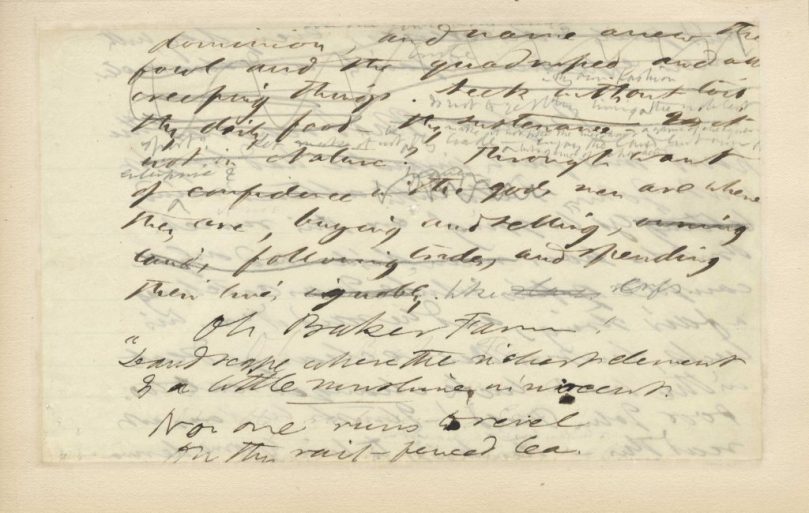
I wish my townsmen to consider that, whatever the human law may be, neither an individual nor a nation can ever deliberately commit the least act of injustice without having to pay the penalty for it. A government which deliberately enacts injustice, and persists in it! – it will become the laughing-stock of the world.
4/9/19
Thoreau, April 7, 1857
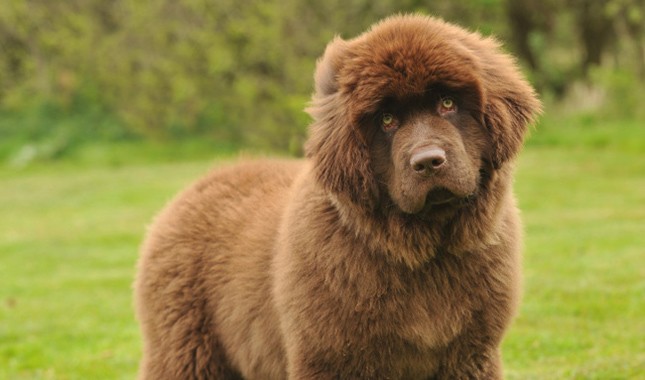
April 7. Tuesday. Went to wall:in the woods. WhenI had got half a mile or more away in the woods alone,and was sitting oil a rock, Nvas surprised to be joinedby It’s large Newfoundland dog Ranger, who hadsmelledme out and so tracked me.Would that I could add his woodcraft to my own! He would trot along before me as far as the winding wood-path allowed me to see him, and then, with the shortest possible glance over his shoulder, ascertain if I was following. At a fork in the road he would pause, look back at me, and deliberate which course I would take.
 Dean’s List