Author: Dr. Dean
Walking on sunshine
Whitman on Emerson

The wonder is, that Emerson—so delicate—so simple—so fine—should have been heard at all. The significant things are quickly told—that he lived at all—that he worked, wrote—and the world listened. And I always feel of Emerson as I do of Christianity: the acceptance of Christianity was not a credit to Jesus, but to the human race, that it could see, and seeing, welcome; as now with Emerson, the tribute, testimony, not to him but to the modern man, that he can compass so much.
Walt Whitman as recorded by Horace Traubel
Autumnal Tints
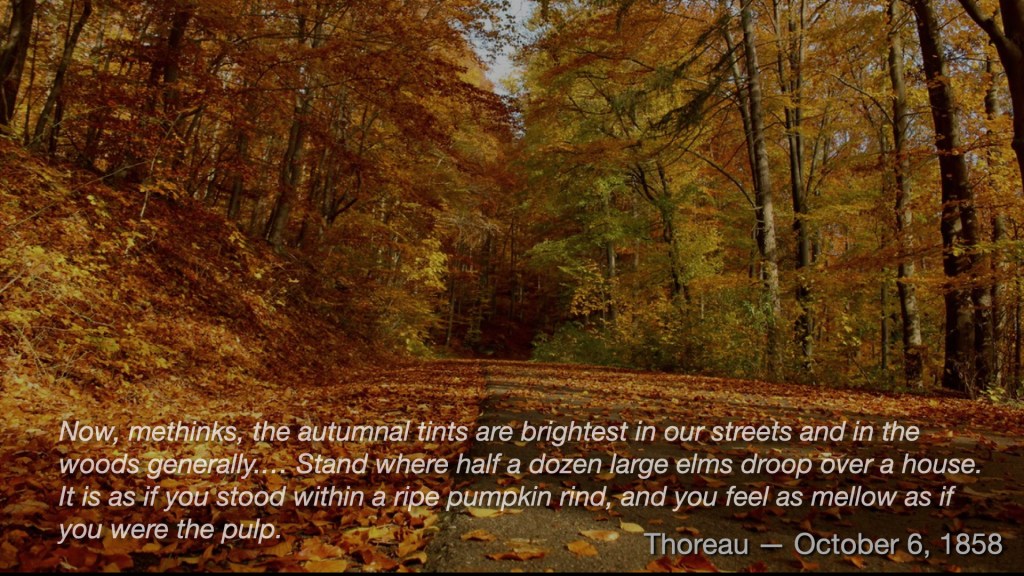
Now, methinks, the autumnal tints are brightest in our streets and in the woods generally.… Stand where half a dozen large elms droop over a house. It is as if you stood within a ripe pumpkin rind, and you feel as mellow as if you were the pulp. Thoreau – October 6 1858
There is no plateau . . .
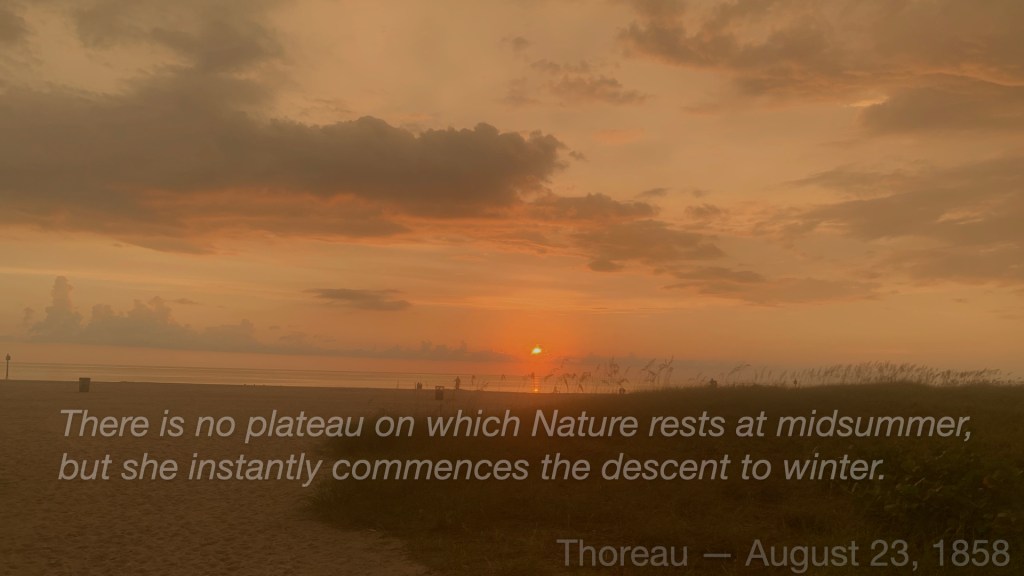
There is no plateau on which Nature rests at midsummer, but she instantly commences the descent to winter. Thoureau – August 23, 1858
Live in each season . . .

“Live in each season as it passes—breathe the air, drink the drink, taste the fruit, & resign yourself to the influences of each. Thoreau– August 23, 1853
How Walt Whitman Writes A Poem
Cool reading.
Thoreau on Sickness
Only Another Orphan
“On the second day, a sail drew near, nearer, and picked me up at last. It was the devious-cruising Rachel, that in her retracing search after her missing children, only found another orphan.” Herman Melville, Moby Dick
Self Reliance and Compensation

Doug Anderson, my first and most beloved philosophy teacher . . . told me that “Self-Reliance” was never to be read by itself, that Emerson had written a sister essay called “Compensation.” He suggested that I read the two in tandem. I did, but it didn’t make sense to me. The two seemed diametrically opposed. In short, “Compensation” argues that no matter how hard you work, no matter how desperately you strive to free yourself from natural or societal constraints, you’ll inevitably fail. Or at least eventually need a break. For the Emerson of “Compensation,” brazen self-assertion was, at best, counterproductive because it failed to recognize something basic about human nature—namely, that it was part of, rather than apart from, the workings of nature. Self-reliance, properly understood, was always situated, ever so carefully, in a wider cosmic order. “Human labor, through all its forms, from the sharpening of a stake to the construction of a city or an epic, is one immense illustration of the perfect compensation of the universe. The absolute balance of Give and Take.
— John Kaag. American Philosophy
When Mindlessness Is Better Than Mindfulness

Sometimes, don’t pay so much attention (Scientific American).
 Dean’s List